Guido Cadorin
TIMELINE
1892
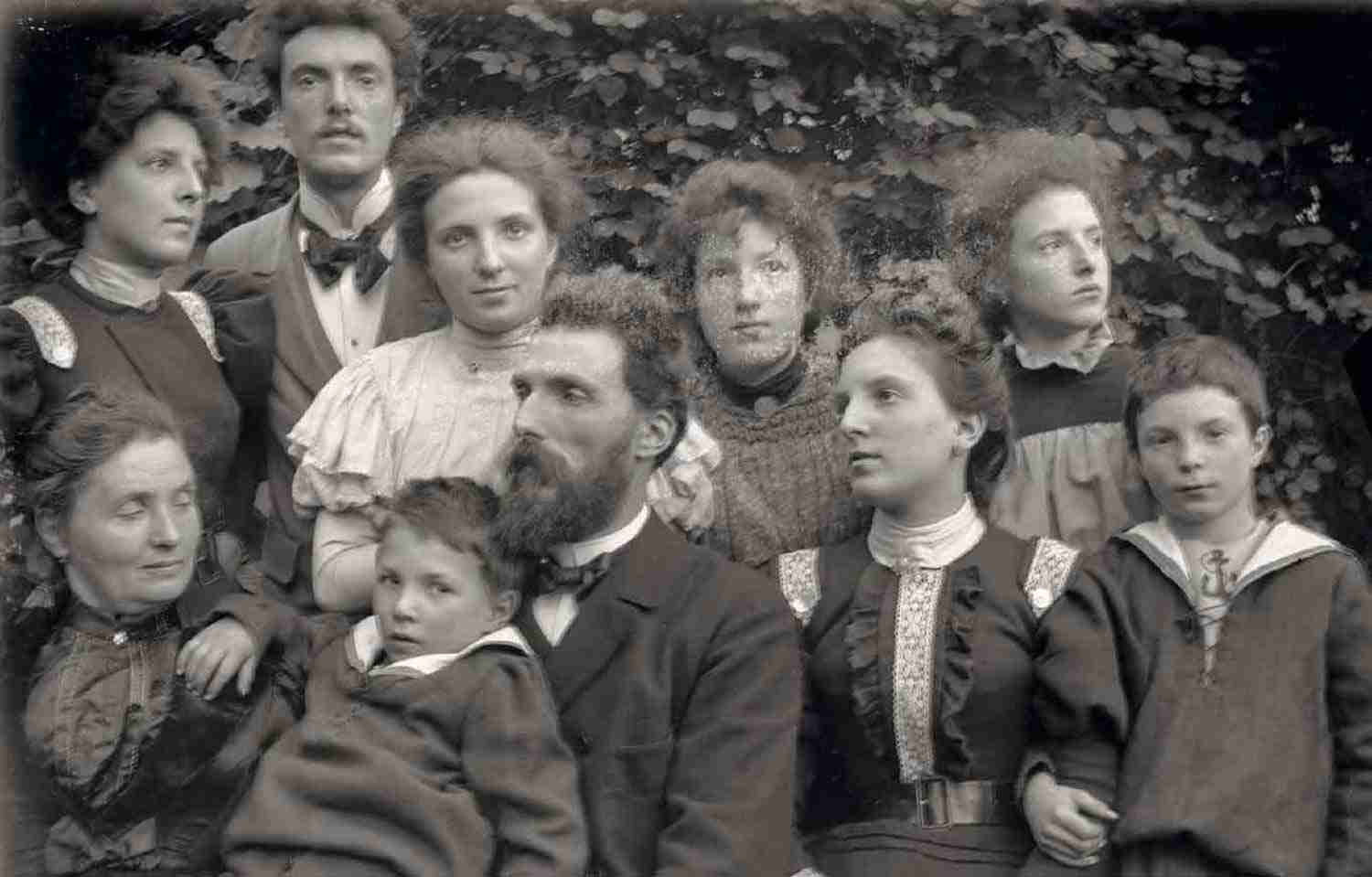
Little Guido between his mother Matilde, father Vincenzo, sisters and brothers.
Guido Cadorin in born in Venice on 6 June: he was the eleventh son of the sculptor, carver and cabinetmaker Vincenzo and Matilde Rocchin. His father, an Art Nouveau artist particularly appreciated by Queen Margherita of Savoy, descended from a family that included members of one of the seven ‘stone–cutter’ workshops favoured by the Republic. Guido’s siblings were also artists: Ettore, the eldest, a sculptor and lecturer at Columbia University; Romeo, also a sculptor; and his sister Ida, a refined draughtsman and watercolourist, who married architect Piero Osghian and died at a young age.
Little Guido between his mother Matilde, father Vincenzo, sisters and brothers.
1906 - 1908
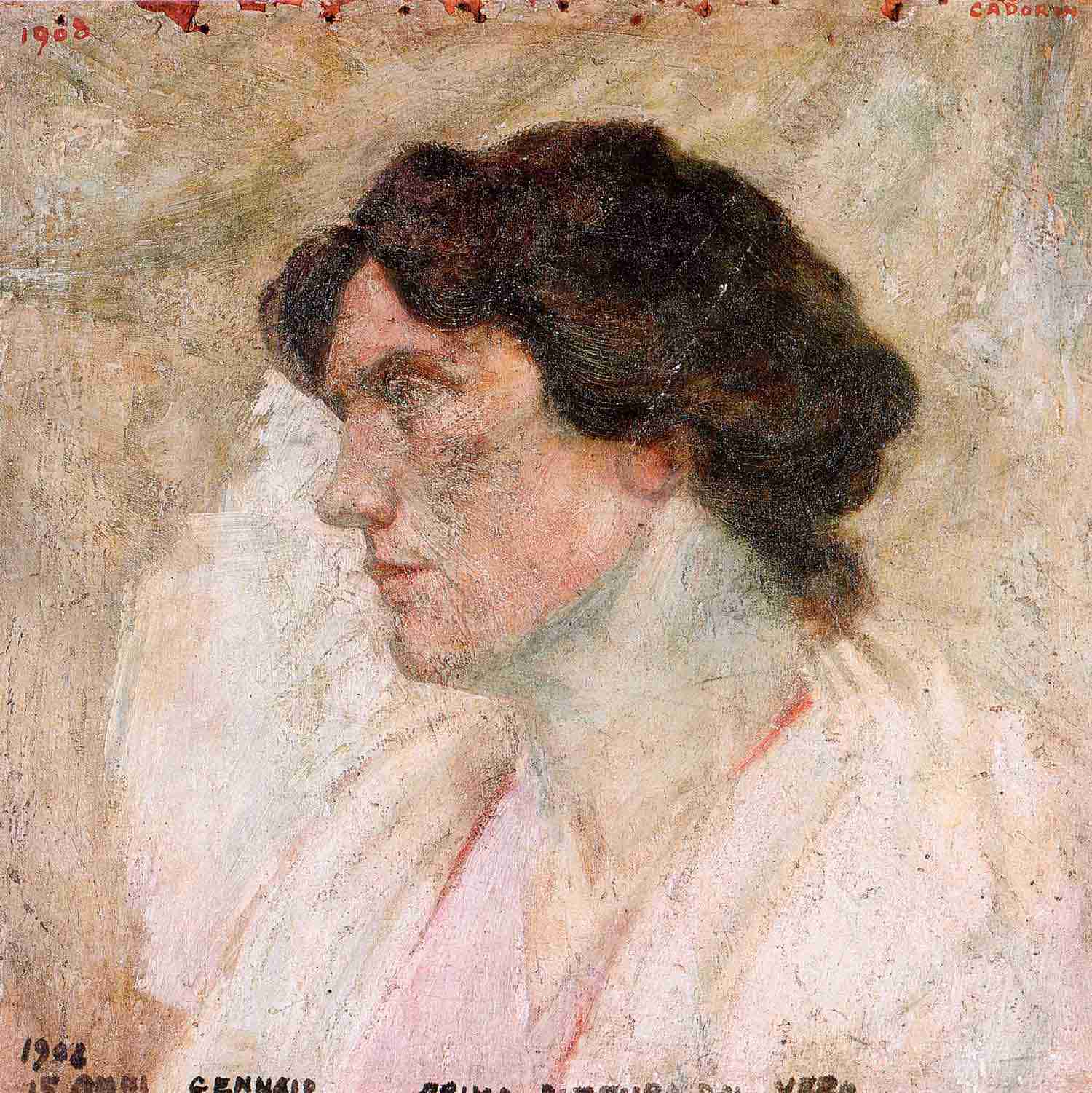
Head of a Woman, 1908, oil on card, 44.6 x 48.5 cm, Museo d’Arte Moderna Mario Rimoldi, Cortina d’Ampezzo (Belluno). Annotation in lower margin: “1908 / 15 anni gennaio prima pittura dal vero”.
He attends the studio of painter Duilio Korompay, and the following year becomes a pupil of Cesare Laurenti. He attends the Accademia di Belle Arti (although enrolled at the Liceo Ginnasio Marco Polo) where he meets Ettore Tito and some young artists: among them Amedeo Modigliani, Fabio Mauroner and Guido Marussig. His friendship with Brenno del Giudice, a future architect, who would marry one of Guido’s sisters, Tullia, also dates back to these high school years. In 1908, at the age of sixteen, he is among the exhibitors at Ca’ Pesaro.
Head of a Woman, 1908, oil on card, 44.6 x 48.5 cm, Museo d’Arte Moderna Mario Rimoldi, Cortina d’Ampezzo (Belluno). Annotation in lower margin: “1908 / 15 anni gennaio prima pittura dal vero”.
1909
Debut at the Venice Biennale with works of applied art exhibited in the room dedicated to the Cadorin family.
1910
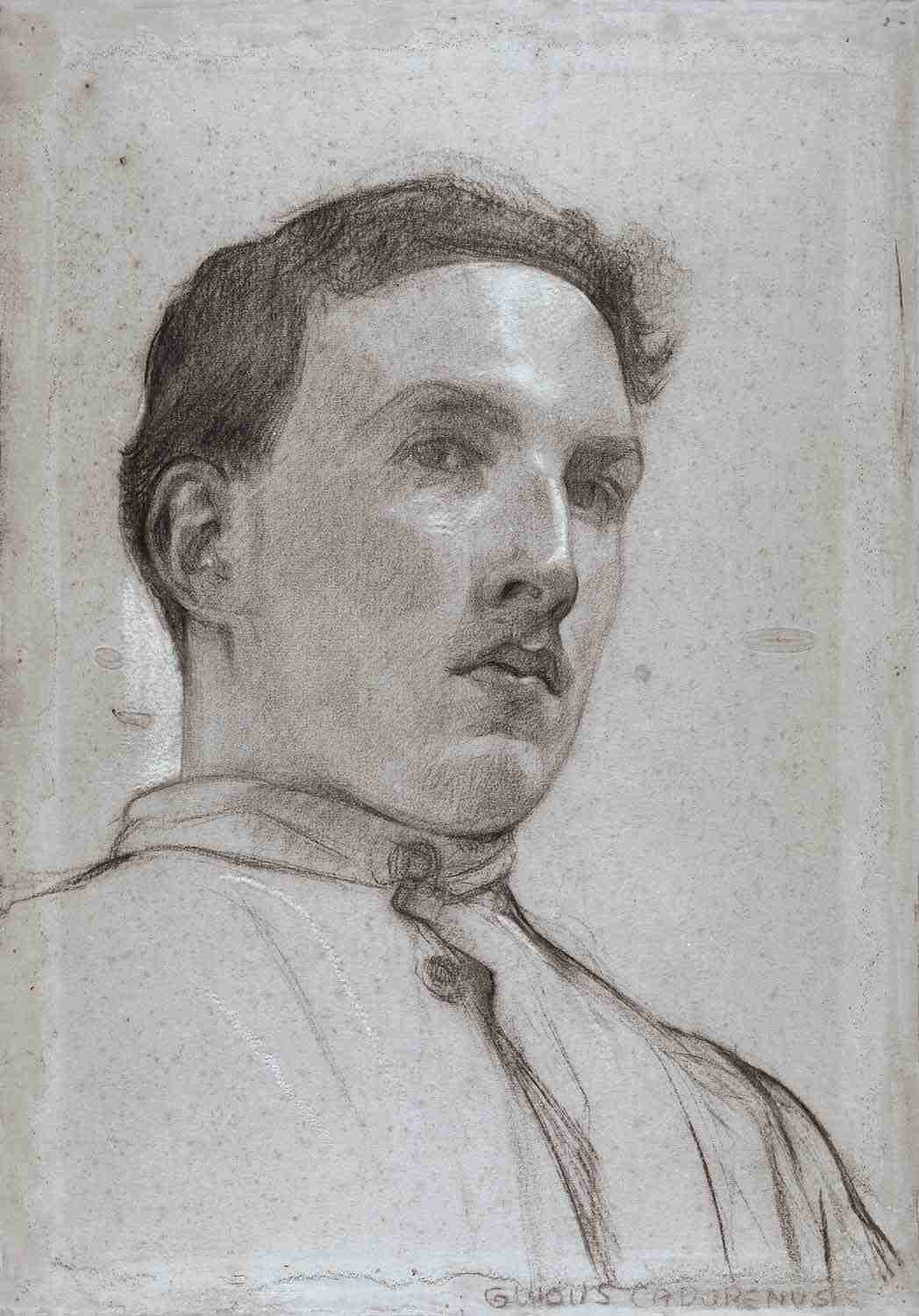
Self–Portrait, 1910, charcoal on paper, 45 x 31 cm
He is present at both exhibitions at Ca’ Pesaro and begins a cycle of frescoes, completed the following year, in the church next to the Visitazione monastery in San Vito al Tagliamento.
Self–Portrait, 1910, charcoal on paper, 45 x 31 cm
1911
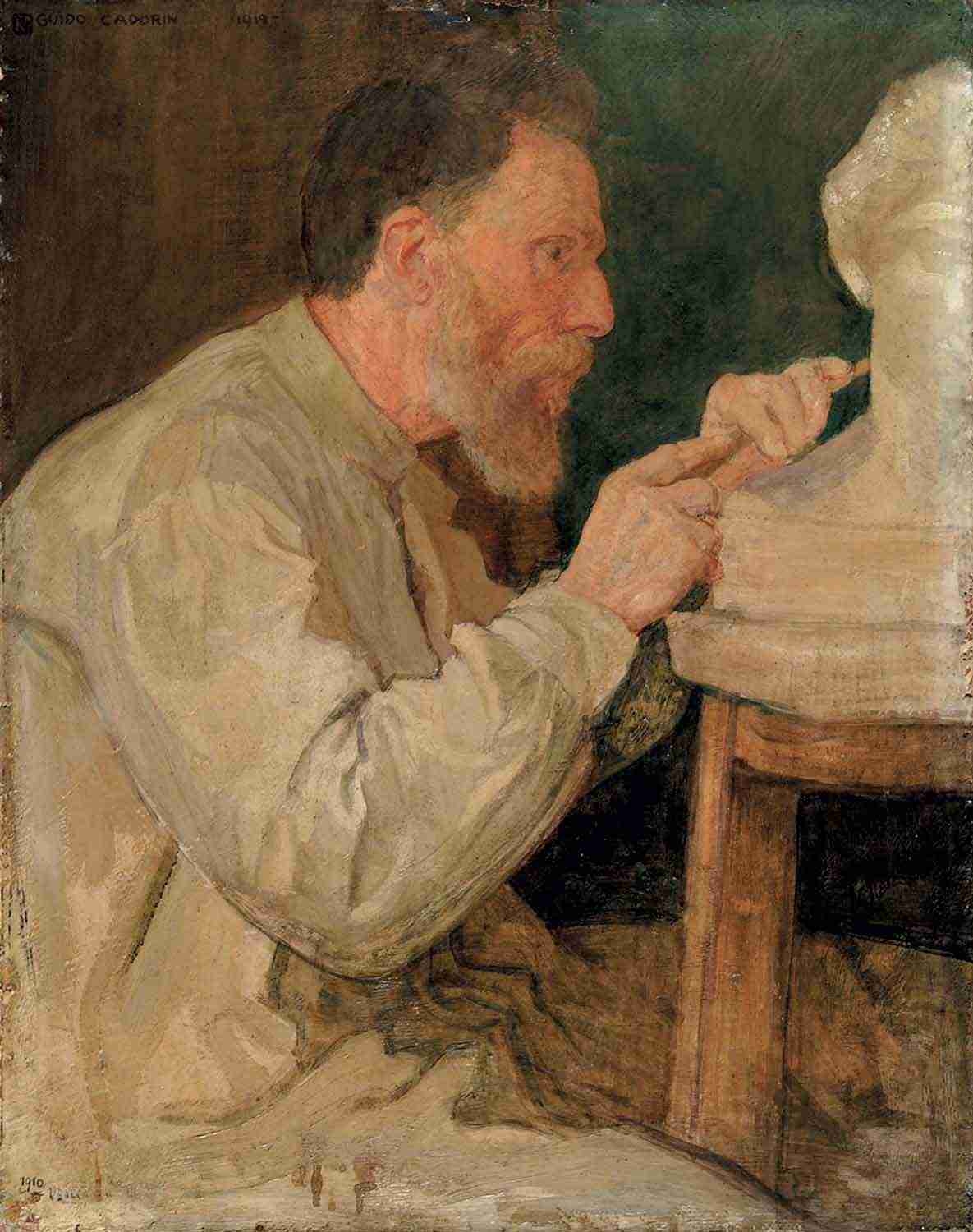
Ritratto di mio padre (Portrait of my father), 1910, tempera on card 83 x 62 cm.
He participateD in the First International Exhibition in Rome with La beghina (1909), L’offerta (1909) and Ritratto di mia madre (1910), while at the Carnegie Institute in Pittsburgh he exhibits Ritratto di mio padre (1910).
I received an invitation from Marinetti (…) to join ‘Futurism’. I, a spiritualist and chaste vegetarian, was outraged and after reading the books, I stupidly burned them and did not respond. I later became friends with Marinetti in 1929 – and was present at his marriage to Benedetta – at the Ivancich house. And in 1936 – in Rome ––I find him and he tells me: ‘I was in Venice to see the exhibition of the greatest painter in the world. Titian at Cà Pesaro’.
Testimony of the artist, from a manuscript kept in the BCM archive.
Ritratto di mio padre (Portrait of my father), 1910, tempera on card 83 x 62 cm.
1912
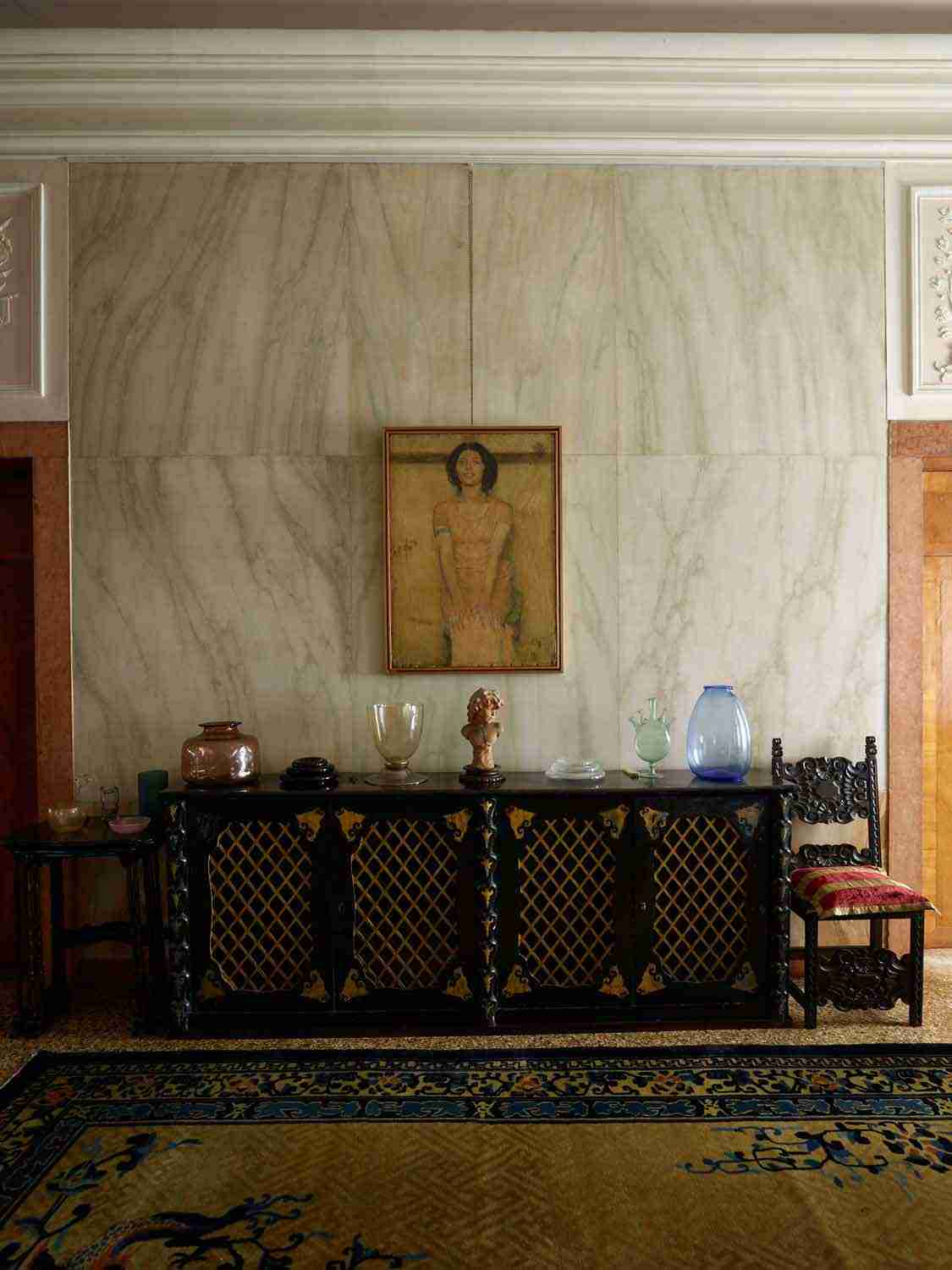
L’idolo (The Idol) in Ida Barbarigo’s house–studio, Palazzo Balbi Valier, Venice (photo Laziz Hamani).
He exhibits the painting L’idolo (1911) at the Mostra dei rifiutati di Brera held at the Caffè Cova in Milan. He exhibits at Ca’ Pesaro together with the young people of the Aratro group, coordinated by Teodoro Wolf Ferrari.
L’idolo (The Idol) in Ida Barbarigo’s house–studio, Palazzo Balbi Valier, Venice (photo Laziz Hamani).
1914
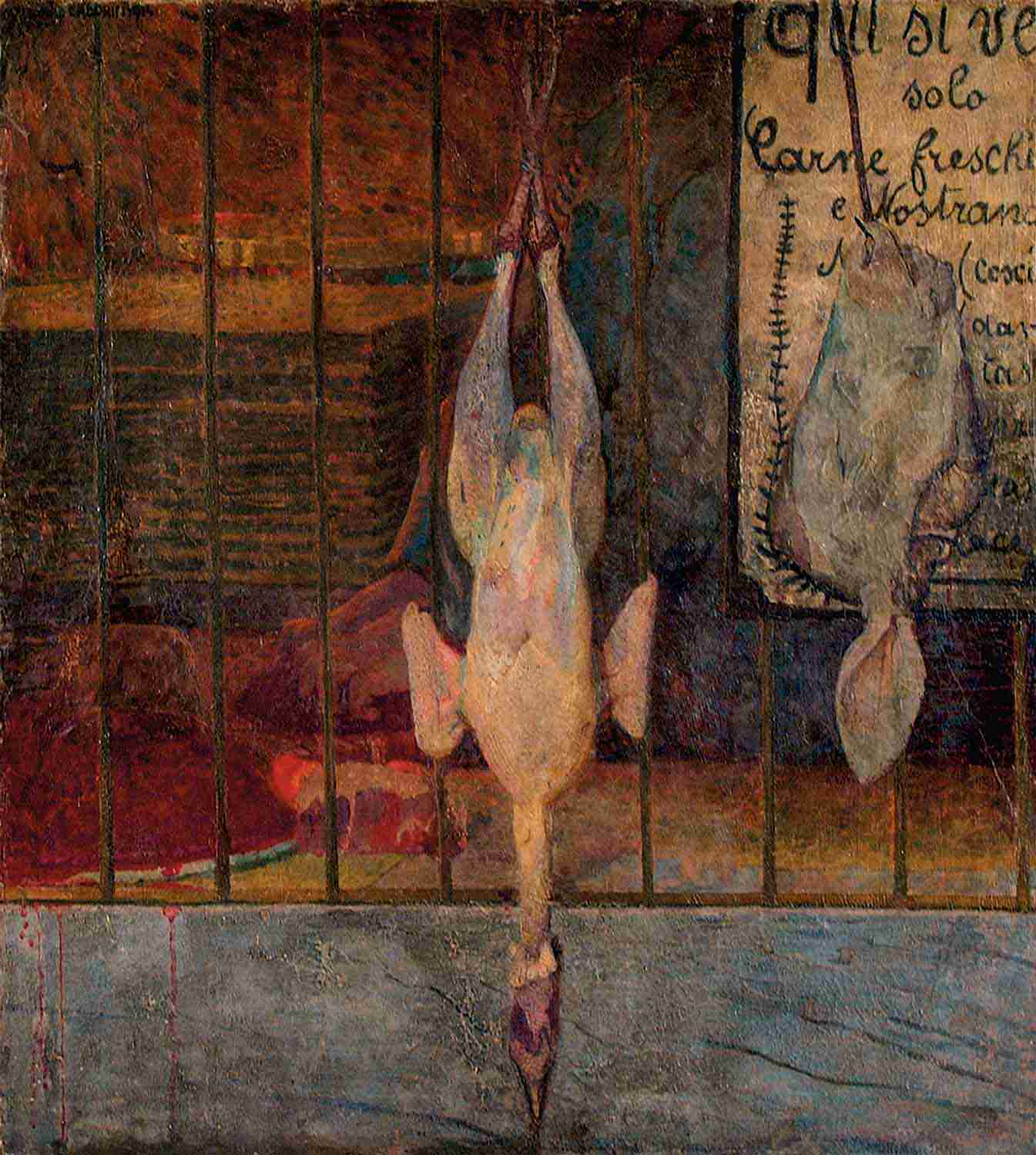
Il Tacchino (Turkey), 1914, oil on canvas 100 x 100 cm. One of the three canvases that make up the triptyc Carne, carne, carne (Meat, meat, meat).
He exhibits both at the Roman Secession exhibition (where he was also present the year before) and at the exhibition of some artists rejected by the Venice Biennale, held at the Excelsior Palace Hotel on the Venice Lido.
Il Tacchino (Turkey), 1914, oil on canvas 100 x 100 cm. One of the three canvases that make up the triptyc Carne, carne, carne (Meat, meat, meat).
1915
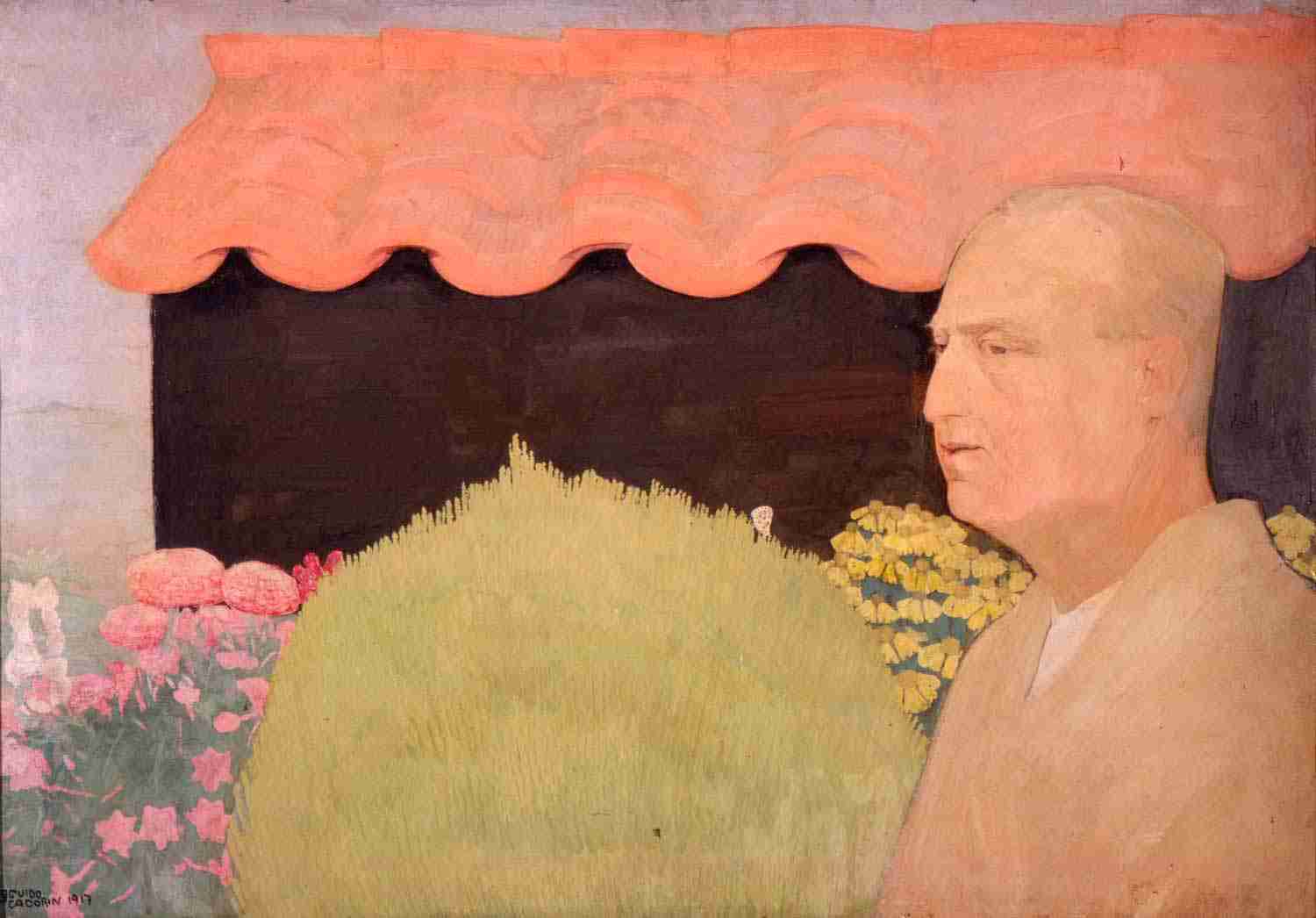
Ritratto del Capitano (Il Giardiniere del giardino fiorito) (Portrait of the Captain (The gardener from the flower garden), 1917, tempera on panel 70 x 98 cm, Boulogne–Billancourt, Musée des Années 30.
He exhibits again at the Secession exhibition in Rome, where Queen Margherita buys one of his paintings, Barche. Drafted in the war with the rank of sergeant, he is posted to Mestre and later to San Nicolò del Lido. His captains are first a Tuscan, Roberto Papini, director of the Galleria Nazionale d’Arte Moderna in Rome, then a Sicilian, De Micheli, who is portrayed by the artist in the famous Ritratto del Capitano (1917).
Ritratto del Capitano (Il Giardiniere del giardino fiorito) (Portrait of the Captain (The gardener from the flower garden), 1917, tempera on panel 70 x 98 cm, Boulogne–Billancourt, Musée des Années 30.
1917
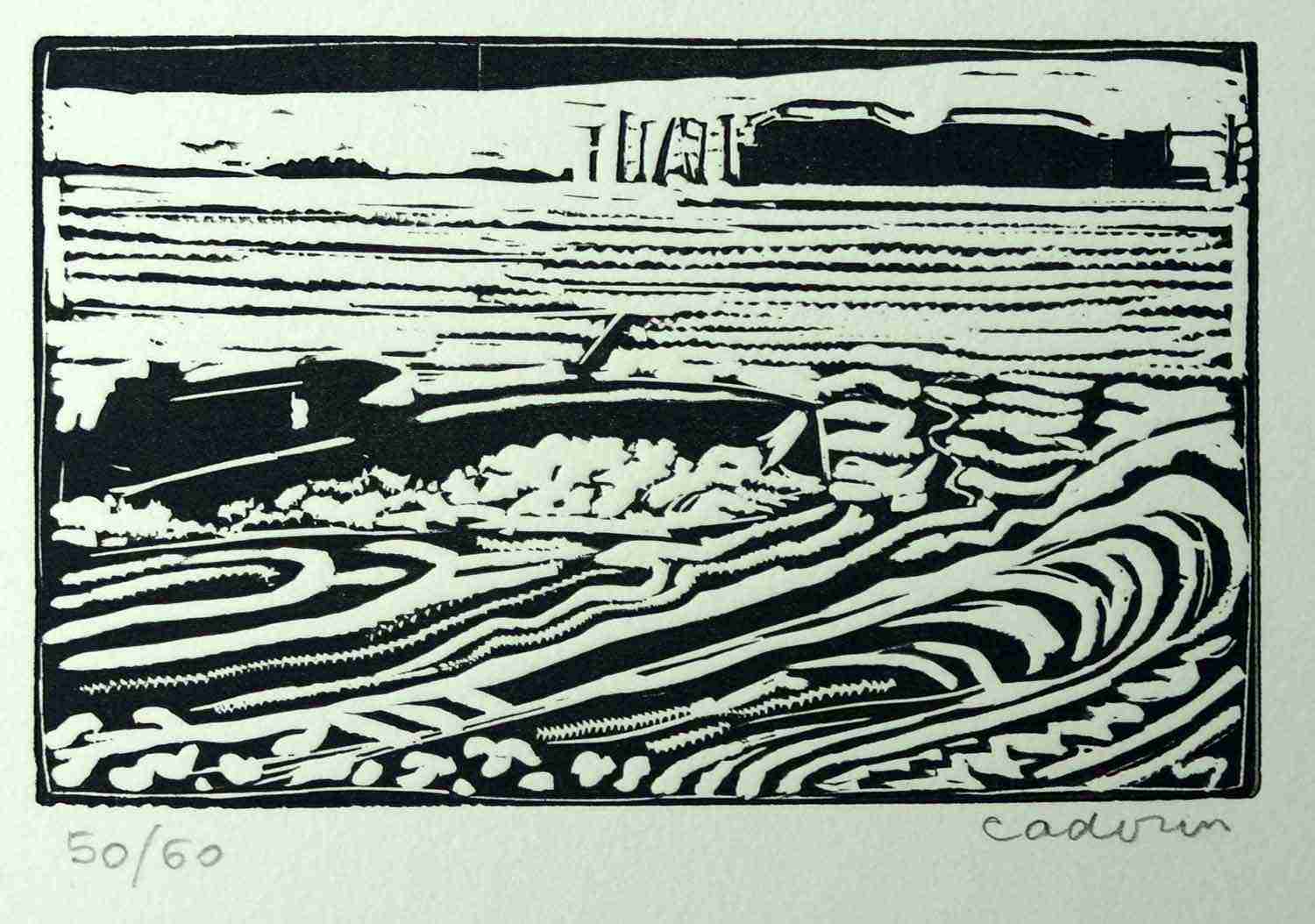
Woodcut from the Venezia di guerra series, 1917.
He marries Livia Tivoli Fiorini, a painter and poet, formerly his pupil. He also executes the series of woodcuts dedicated to Venezia di guerra (Venice at war).
Woodcut from the Venezia di guerra series, 1917.
1918
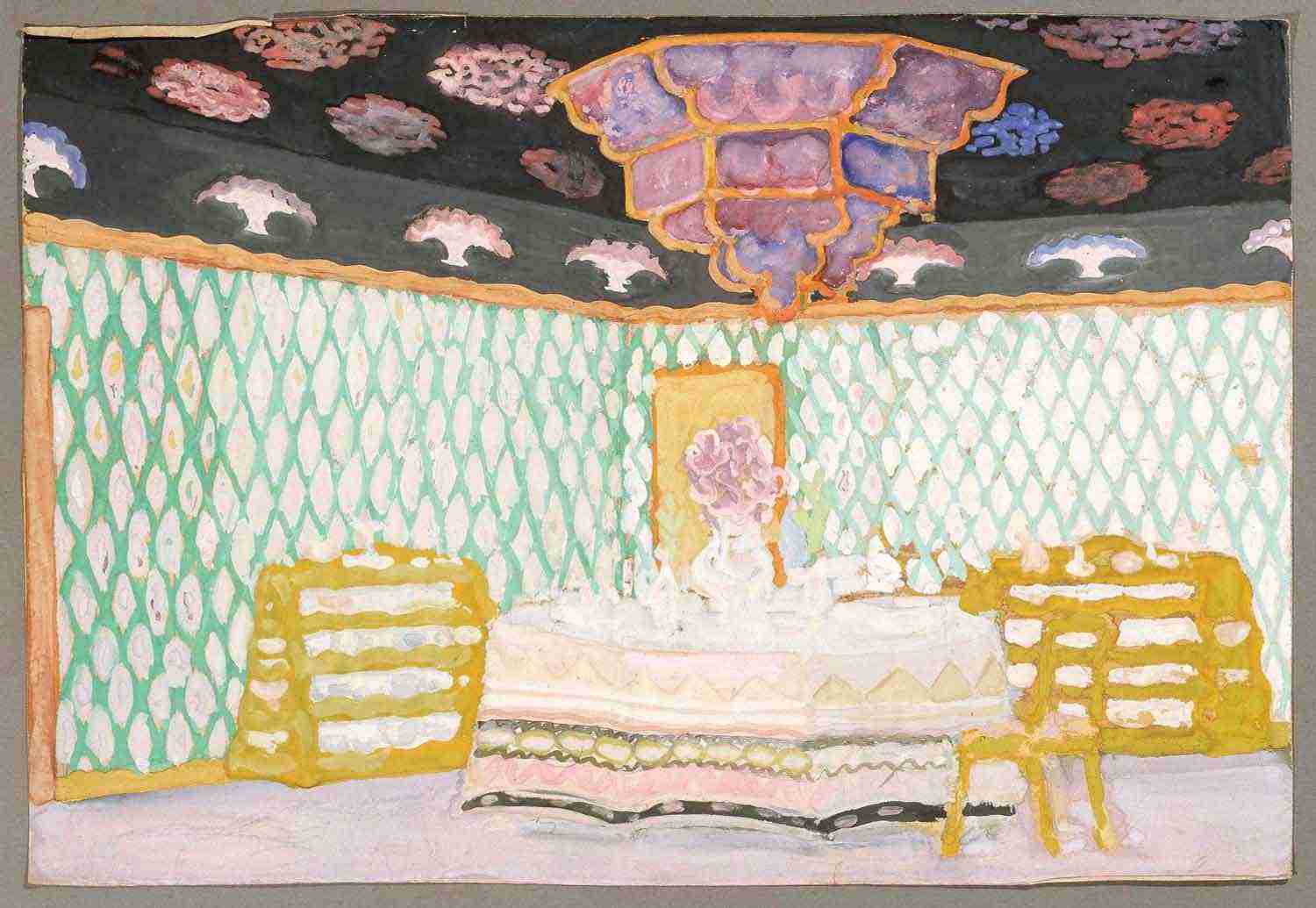
Gouache study for the dining room of Villa Papadopoli
On 31 October his eldest son, Paolo, is born. A major commission comes his way following his discharge from the army: the decoration and complete furnishing of Count Nicolò Papadopoli’s villa in Vittorio Veneto, the architectural restoration of which is entrusted to Brenno del Giudice.
I thought of the interior of this villa as a colourful symphony… The sumptuous dining room had black lacquer ceilings and doors, with garish flowers on the ceiling – in tempera and white still life columns on the frieze woodwork all around. Then on the wall a carving with a kind of green trellis – on a white background – and flowers and leaves and butterflies – hand–woven… And then all around some shaped furniture in a deep chrome yellow shade, covered with peach blossom marble – a large oval table of yellow lacquer and matching chairs. And a dark blue carpet on the floor.
The artist quoted by Isabella Campagnol, ‘Umberto Bellotto e Guido Cadorin. Tra arte e design tessile negli anni Venti” in Atti della Giornata di Studi “Eugenio Da Venezia” 2012, Fondazione Querini Stampalia, Venice – Fondazione Museo Civico di Rovereto, 2014 p. 41.
Gouache study for the dining room of Villa Papadopoli
1919
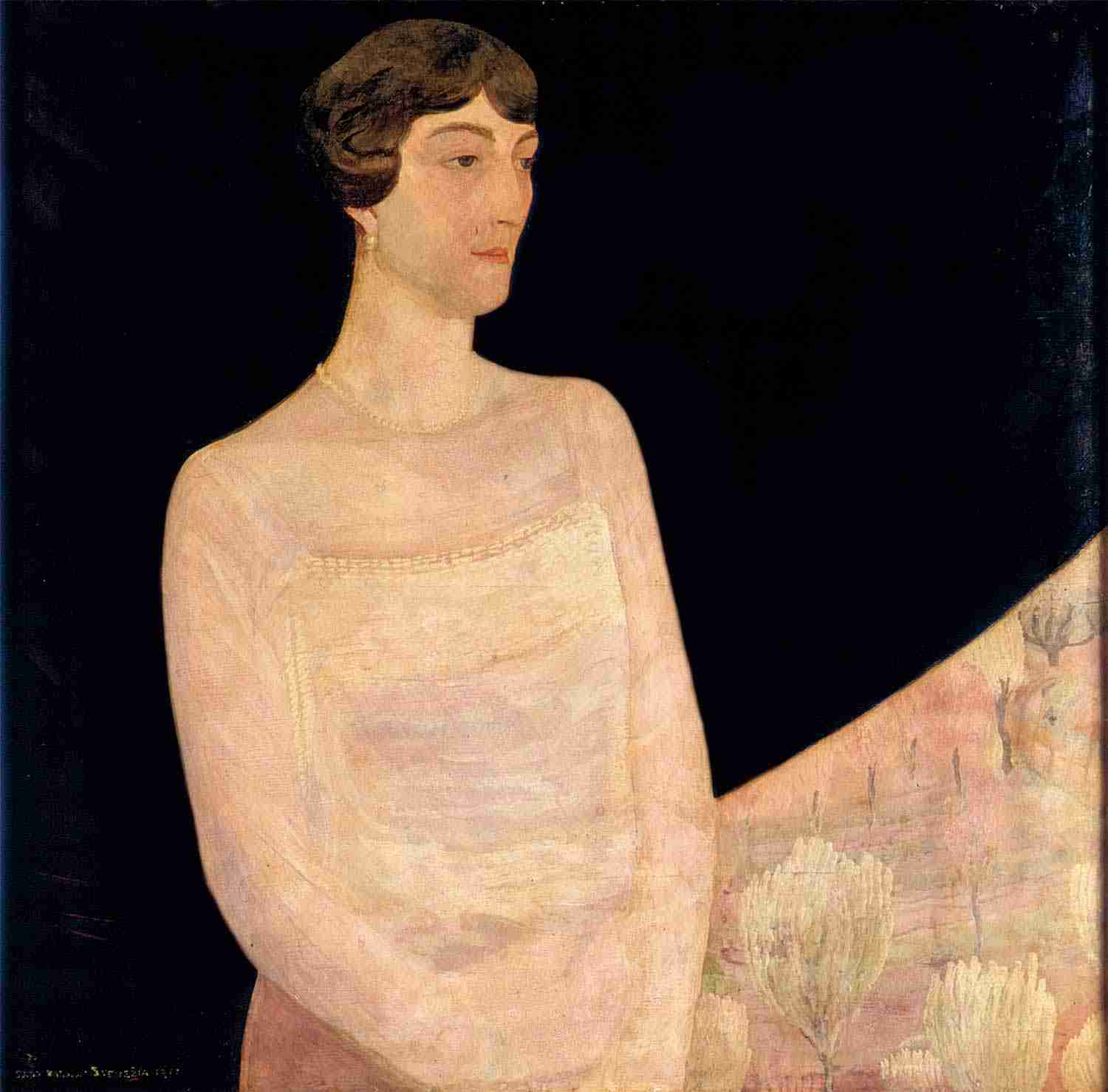
Signora e giardino primaverile (Lady and Spring Garden), 1919, tempera on card 97 x 99 cm.
He finishes work on Villa Papadopoli and exhibits a number of works at Ca’ Pesaro. Among them, the portrait of Baroness Fanny Winspeare (Signora e giardino primaverile). He is present at the first Esposizione del Circolo Artistico at the Geri-Boralevi Gallery in St. Mark’s Square.
Signora e giardino primaverile (Lady and Spring Garden), 1919, tempera on card 97 x 99 cm.
1920
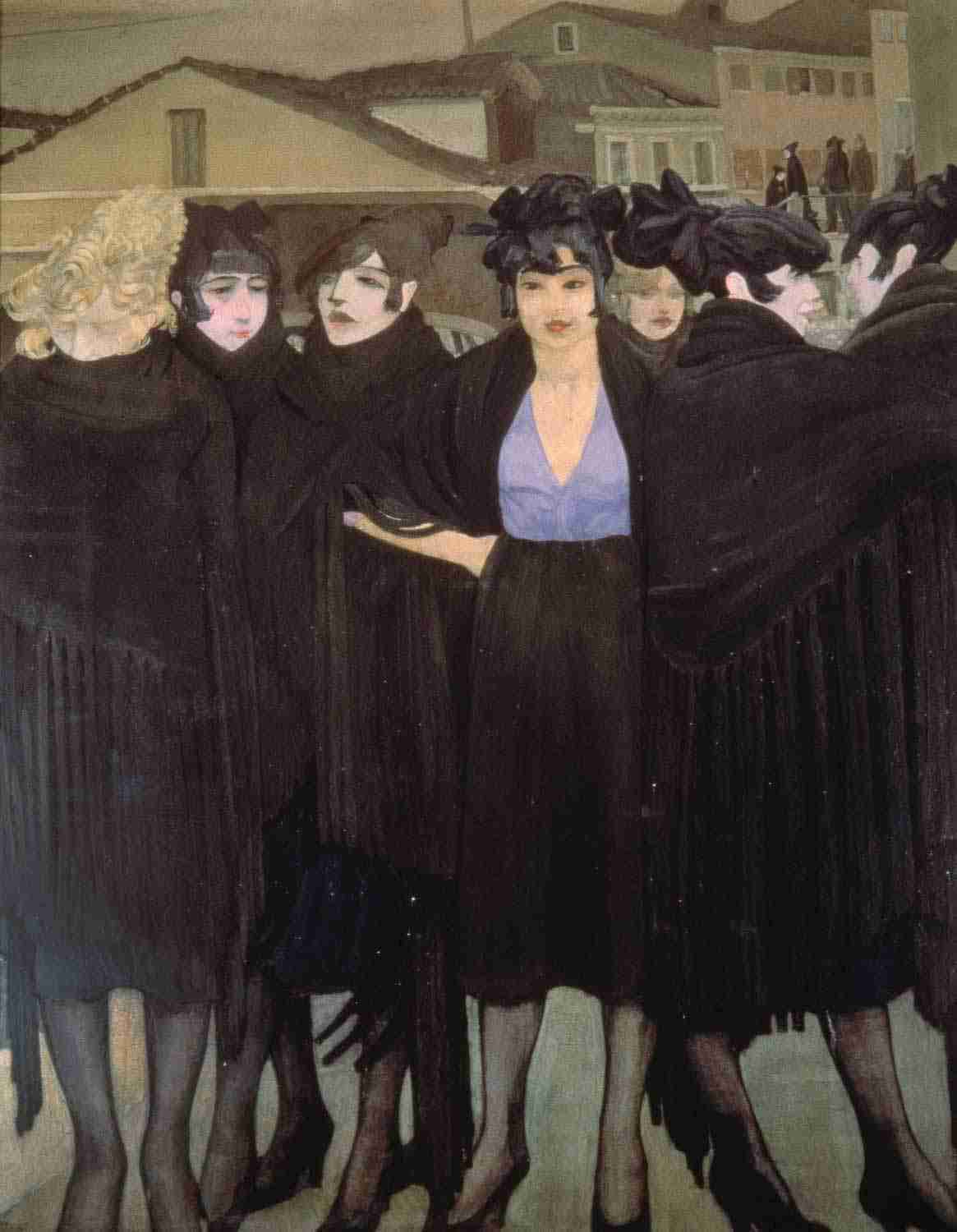
Le tabacchine (The tobacco workers), 1920, oil on panel 150 x 122 cm, Artistic Heritage of the Quirinale, Rome.
Appointed a member of the Hanging Committee of the 12th Venice Biennale, in that edition he exhibits Mia moglie e mio figlio (1919, later cut down) and Le tabacchine (1920), which is bought by the King. He participates in the Mostra Nazionale d’Arte Sacra in Venice (Palazzo Reale) and presents two woodcuts in the competition for two prints depicting two Stations of the Cross. During these years he produces a series of drawings for vases for the Venini company in Murano. On 26 August his daughter Ida is born.
Le tabacchine (The tobacco workers), 1920, oil on panel 150 x 122 cm, Artistic Heritage of the Quirinale, Rome.
1921
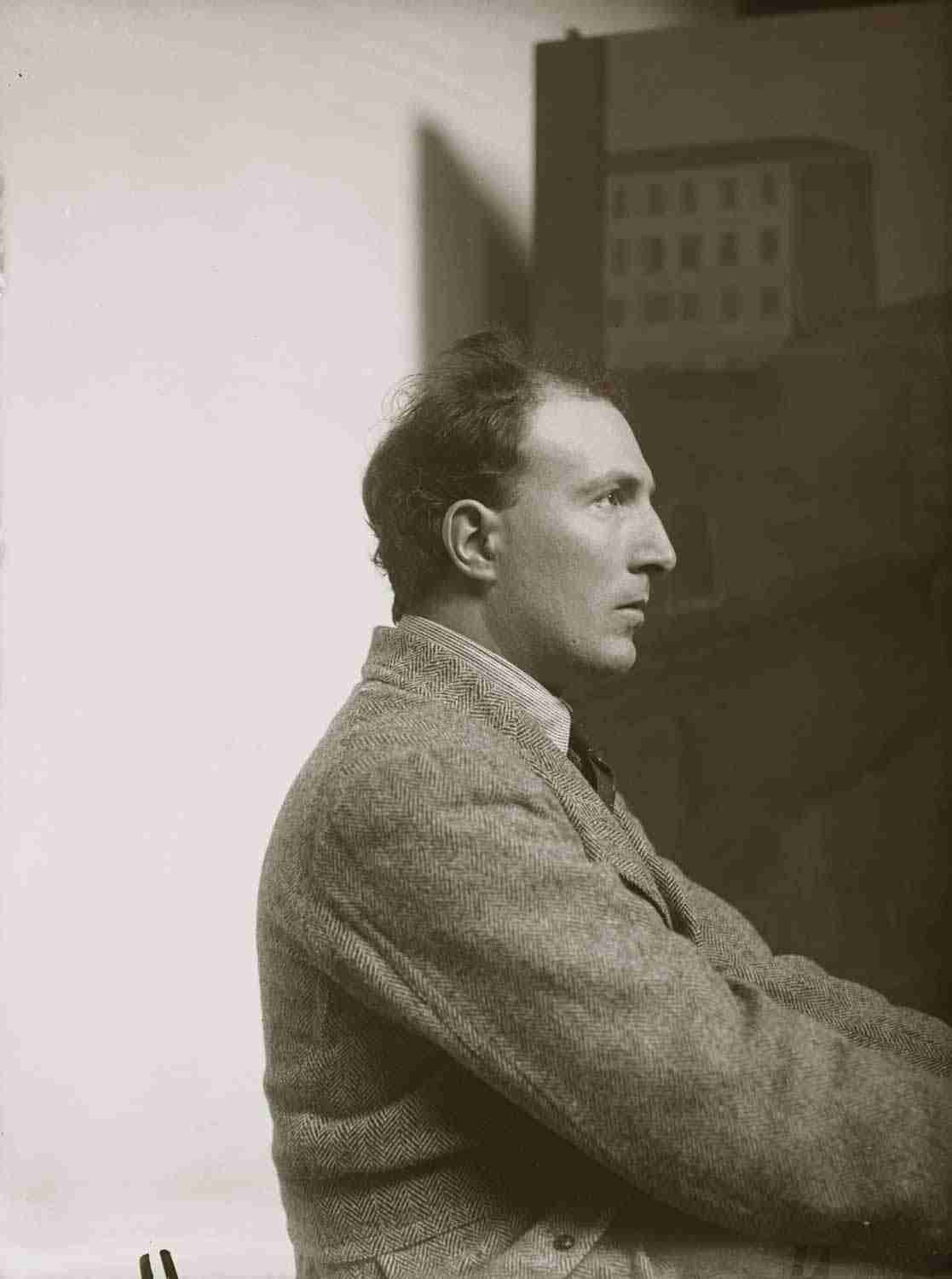
Guido Cadorin in a photo of the time. The painting Il canale can be seen in the background (photo Augusto Tivoli).
He produces some important paintings, including Il canale, Campo della Bragora and the Lagune series, the sketches for which date from the war years. In the same year he takes part in the competition for the decoration of the church of San Francesco in Ravenna and, with the help of Astolfo de Maria and Bortolo Sacchi, he frescoes the parish church of Col San Martino (Treviso).
I am commissioned to do the ceiling at Colsanmartino, in a reconstructed nineteenth-century church. (…) Despite the pittance of the fee, I asked an old room painter, Gobbis from Motta di Livenza, to prepare the colours for me: the earths that I, with a real mania, had been collecting for years in the old shops – leftovers from the Republic that in 1915 I hid as the only precious thing in the convent of the Suore del Soccorso who offered to hide me. De Maria and Sacchi asked me to come and help, to learn how to paint in fresco (…). I would work from morning, never going down to eat. The two friends would go to breakfast, I would work and eat bread and a few pieces of chocolate or grapes, and this until the evening, when I would go downstairs with my eyes wide with fatigue. (…) I loved the Byzantines and I loved Pordenone’s fresco painting at the same time, and from this loving union my three ceiling frescoes were born.
Testimony of the artist, from a manuscript kept in the BCM archives.
Guido Cadorin in a photo of the time. The painting Il canale can be seen in the background (photo Augusto Tivoli).
1922
Again with Bortolo Sacchi, he frescoes the parish church of Vidor (Treviso), which he completes in 1925. He exhibits at the Venice Biennale and at the Mostra Nazionale d’Arte Sacra in Milan. Together with Astolfo de Maria, Sacchi, Martinuzzi, del Giudice and Maranesi, he also attempts to form a group of artists seeking the ‘high patronage’ of Gabriele d’Annunzio. Between 1922 and 1923 he takes part in the competition for an altarpiece for the church in Valdobbiadene, finishing second after Ubaldo Oppi.
1923
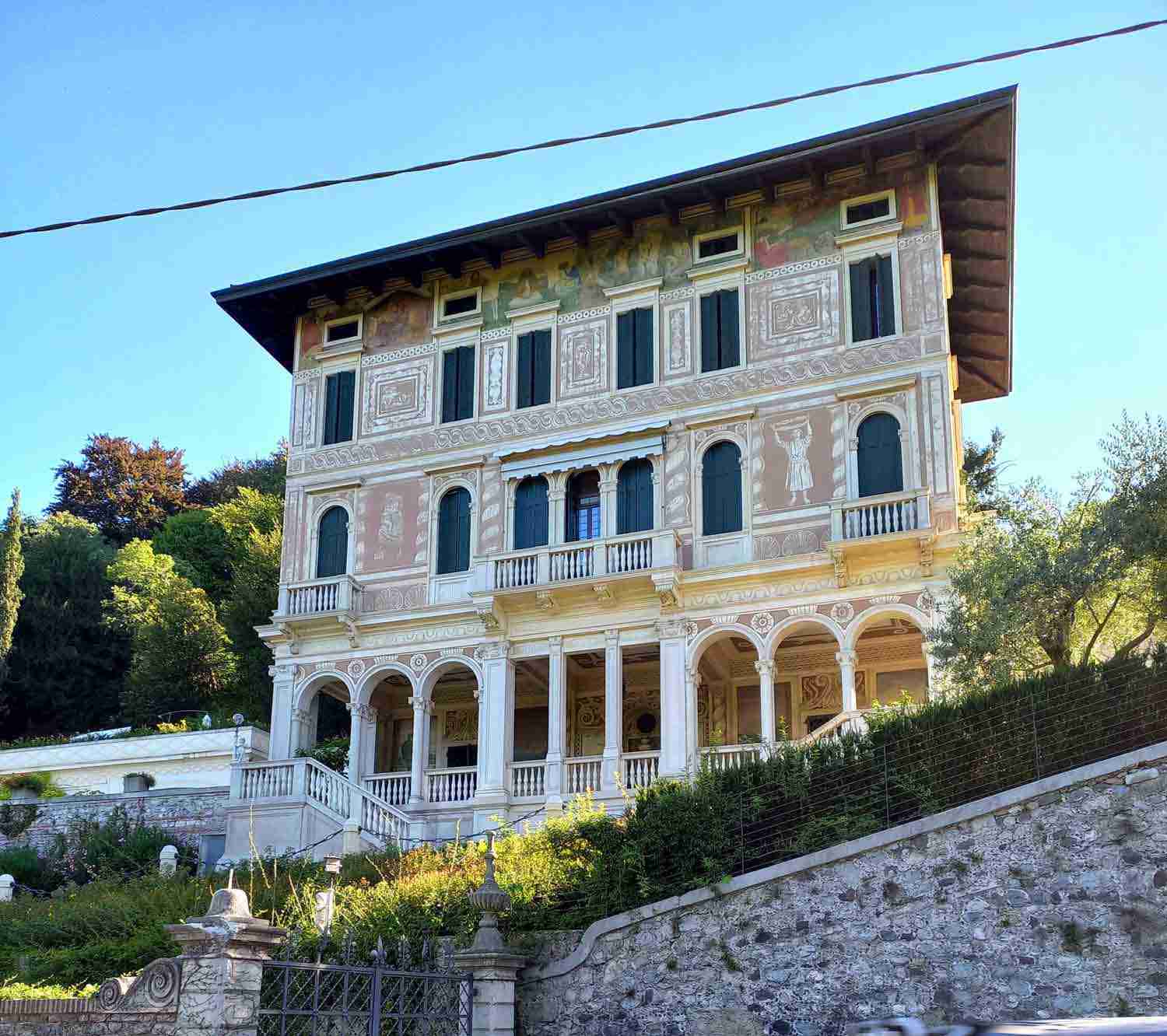
Villa Zadra, Vidor, Treviso.
He frescoes Villa Zadra in Vidor with the help of Giovanni Zanzotto for the decorative parts. He also paints the altarpiece of the Deposizione for the chapel in the castle in the same town, along with the frescoes for the Zadra family chapel in the cemetery, and the decoration of the primary schools named after Innocente Zadra. He exhibits at the Mostra Nazionale d’Arte Decorativa in Monza, at the Galleria Pesaro in Milan, at the Biennale of Liturgical Art in Venice and in travelling exhibition in the Netherlands.
Villa Zadra, Vidor, Treviso.
1924
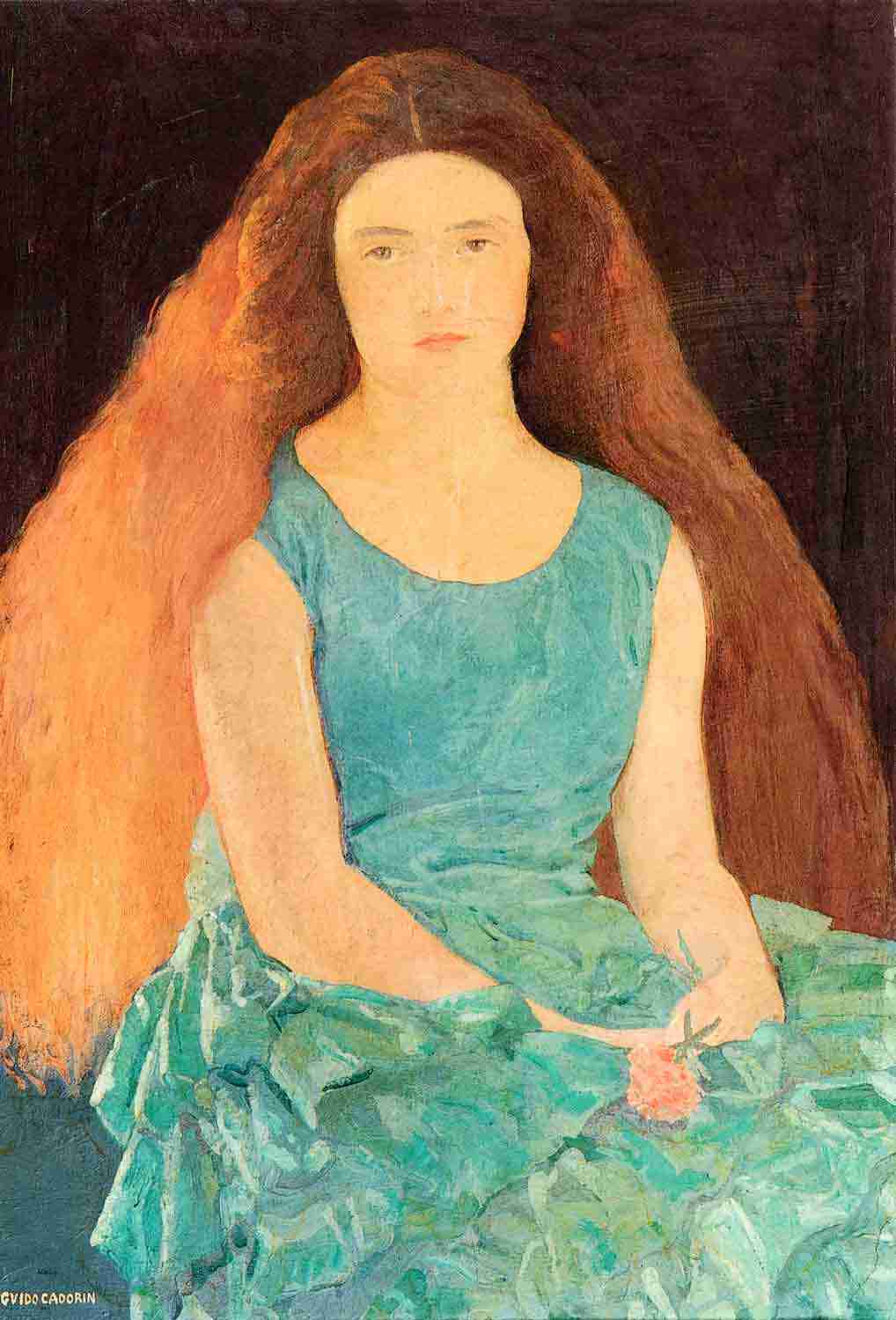
Fanciulla (Maiden), 1924, tempera on card 99.5 x 68 cm, Museo Revoltella, Trieste.
He participates in the 14th Venice Biennale and at the Mostra del Ritratto Femminile Contemporaneo at the Villa Reale in Monza. He is then invited by d’Annunzio to his house, Vittoriale, where he produces the paintings, decorations and drawings for the stained-glass windows of the Zambra del Misello (Stanza del lebbroso) and executed a pencil portrait of the poet.
I met Gabriele d’Annunzio around 1922 at a friend’s house in Venice. (…) after a few years (…) in the spring of 1924, like a thunderbolt, I received his invitation to go to Gardone in the autumn to decorate the room of pure dreams – or the ‘Zambra del misello’, the ‘Leper’s room’. (…) He told me more or less what he would have wanted painted in the room, (…) with the vision of the five women: Sibyl of Flanders, Elizabeth of Hungary, Odylas of Alsace, Judith of Poland, Catherine of Siena, whom I was to paint on the walls or the ceiling at my pleasure. He left me a few hours in meditation, and then, almost by miraculous inspiration – I drew him a schematic composition – as I later did – of the whole. That is, the women on the ceiling with the background of the blue night sky as if they were flying and could be seen from open doors on the ceiling coffers (…).
Testimony of the artist, from a manuscript kept in the BCM archives.
Fanciulla (Maiden), 1924, tempera on card 99.5 x 68 cm, Museo Revoltella, Trieste.
1925
With the collaboration of Astolfo de Maria, he frescoes the church in Moriago della Battaglia (Treviso) and, commissioned by Marcello Piacentini, goes to Tobruk in Libya to decorate the town hall.
1926
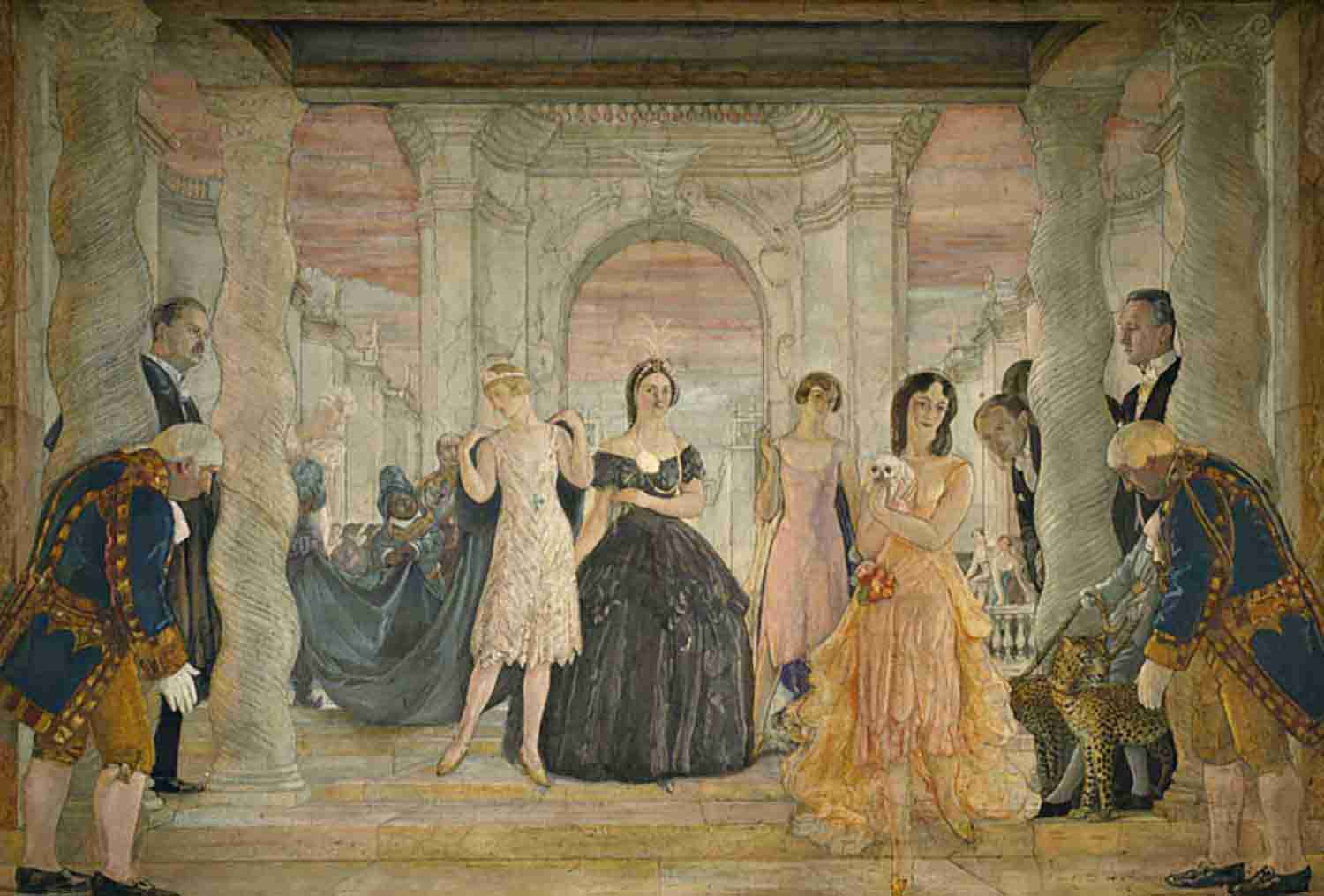
Frescoes for the Ambasciatori Hotel, detail.
He paints the cycle of frescoes for the central atrium of the Ambasciatori hotel in Via Veneto in Rome, designed by architect Marcello Piacentini and with the collaboration of Brenno del Giudice for the squaring off and Melchiorre Bega for the rounded decorations. He exhibits at the Novecento Italiano exhibition at the Palazzo della Permanente in Milan, at the Venice Biennale and at the Exhibition of Modern Italian Art in New York. A competition is announced for the decoration of the apse of the Church of San Giusto in Trieste.
Frescoes for the Ambasciatori Hotel, detail.
1928
He exhibits at the Venice Biennale and at the Galleria Scopinich in Milan, undertakes his first voyage to Paris, produces some works – now lost – in Rome and Milan and creates the altarpiece for the church of San Pietro in Gorizia (now Nova Gorica).
1929
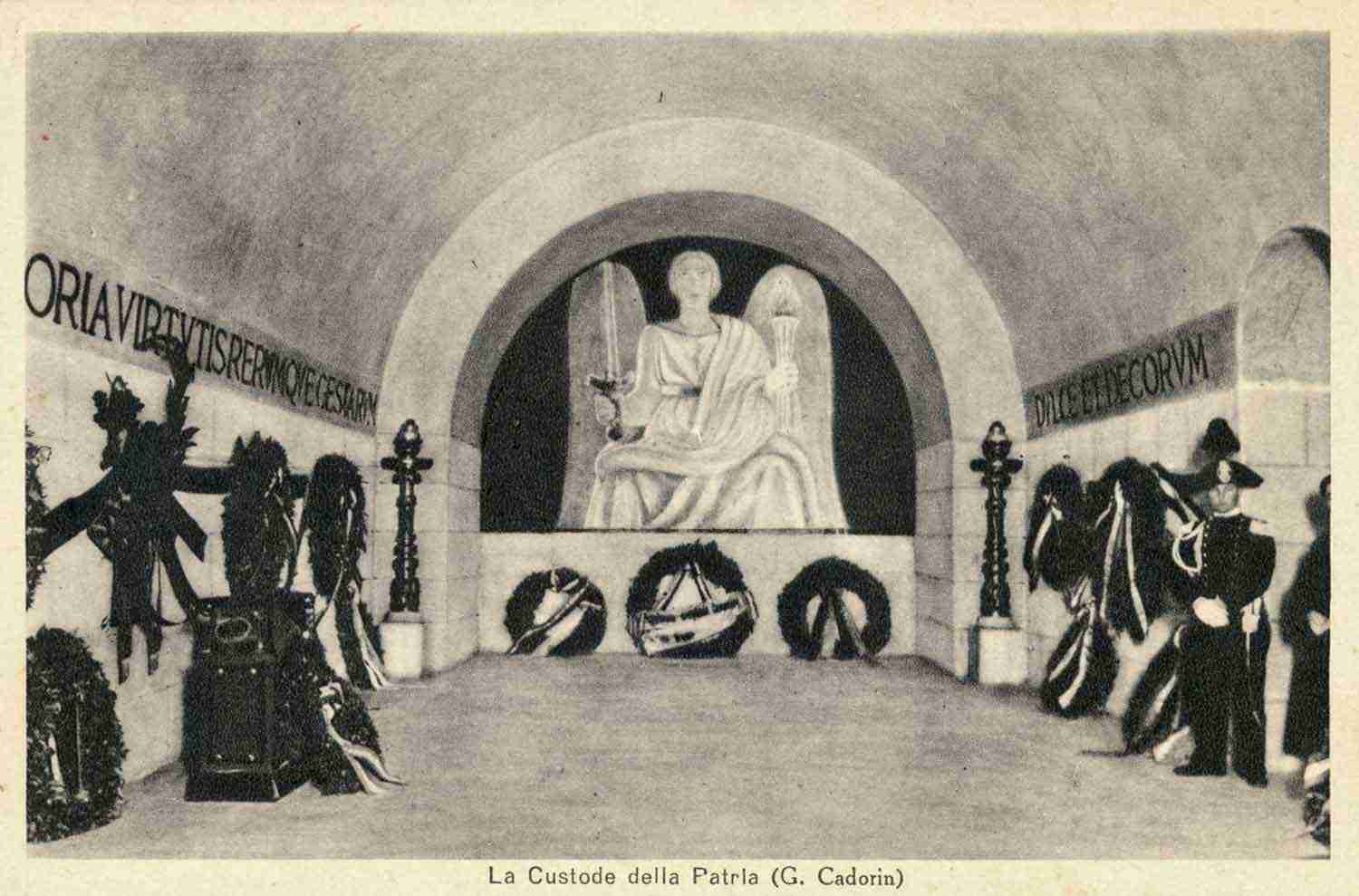
The Bolzano fresco in a period postcard.
He decorates the crypt of the Victory monument in Bolzano. He wins the competition for the cathedral in La Spezia (never realised) in collaboration with Brenno del Giudice and participates in the International Exhibition in Barcelona. He is appointed to the chair of Pictorial Decoration at the Accademia di Belle Arti in Venice.
The Bolzano fresco in a period postcard.
1930
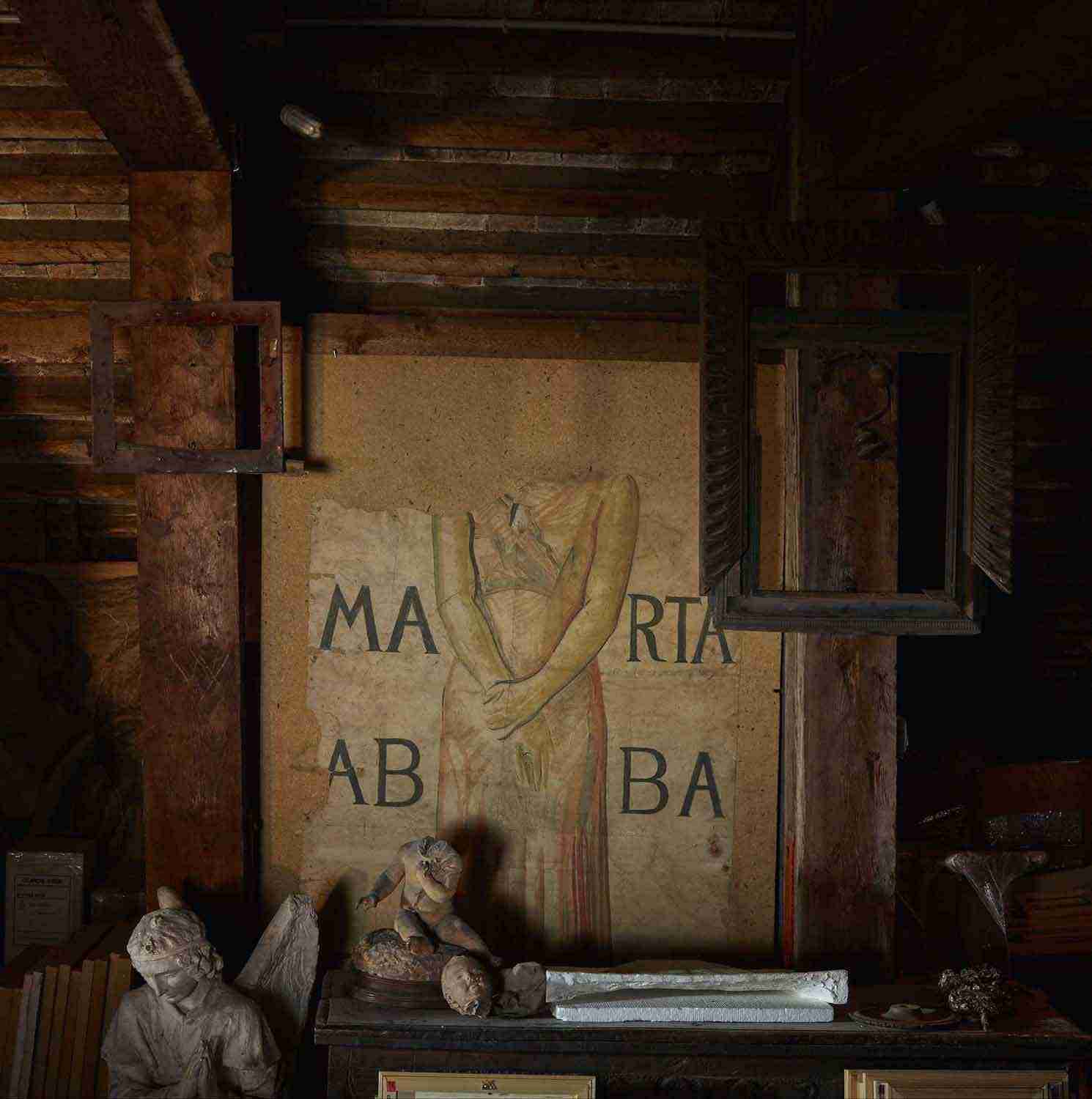
Study for the poster depicting Marta Abba in the attic of Palazzo Balbi Valier (photo by Laziz Hamani).
He begins work on the mosaic decoration of the apse of San Giusto Cathedral in Trieste, which iscompleted in 1933. In 1930 he participates in the Venice Biennale with an important solo exhibition. He begins working with Luigi Pirandello, of whom he paints several portraits.
In October 1930, I was called upon by Luigi Pirandello to do some scenes for Mann’s play, staged by Marta Abba as company alone, for which I did a playbill. Pirandello and Marta Abba’s friendship is an unforgettable thing, with Pirandello giving me a close friendship of a whole month from morning to night; I feel like I am talking to one of the great Greek philosophers, an incomparable man. I can only compare him to Ezra Pound, whose friendship I have had since 1968.
Testimony of the artist, from a manuscript kept in the BCM archive.
Study for the poster depicting Marta Abba in the attic of Palazzo Balbi Valier (photo by Laziz Hamani).
1932
Frescoes for the Palazzo delle Poste in Gorizia, designed by architect Angiolo Mazzoni.
1934
Cadorin participates in the Venice Biennale.
1935
Allegorical frieze for the Italian pavilion at the Brussels International Exhibition, where he also receives the Grand Prix. He decorates the Maison d’Italie in Brussels with frescoes. One of his self-portraits is purchased by the Belgian Government. Exhibition for the 40th anniversary of the Biennale.
1936
He exhibits at the Kley Kamps Gallery in The Hague and wins a prize at the International Art Exhibition in Budapest. He moves from the chair of Decoration to the chair of Painting at the Accademia di Belle Arti in Venice. He also participates in the Venice Biennale.
1938
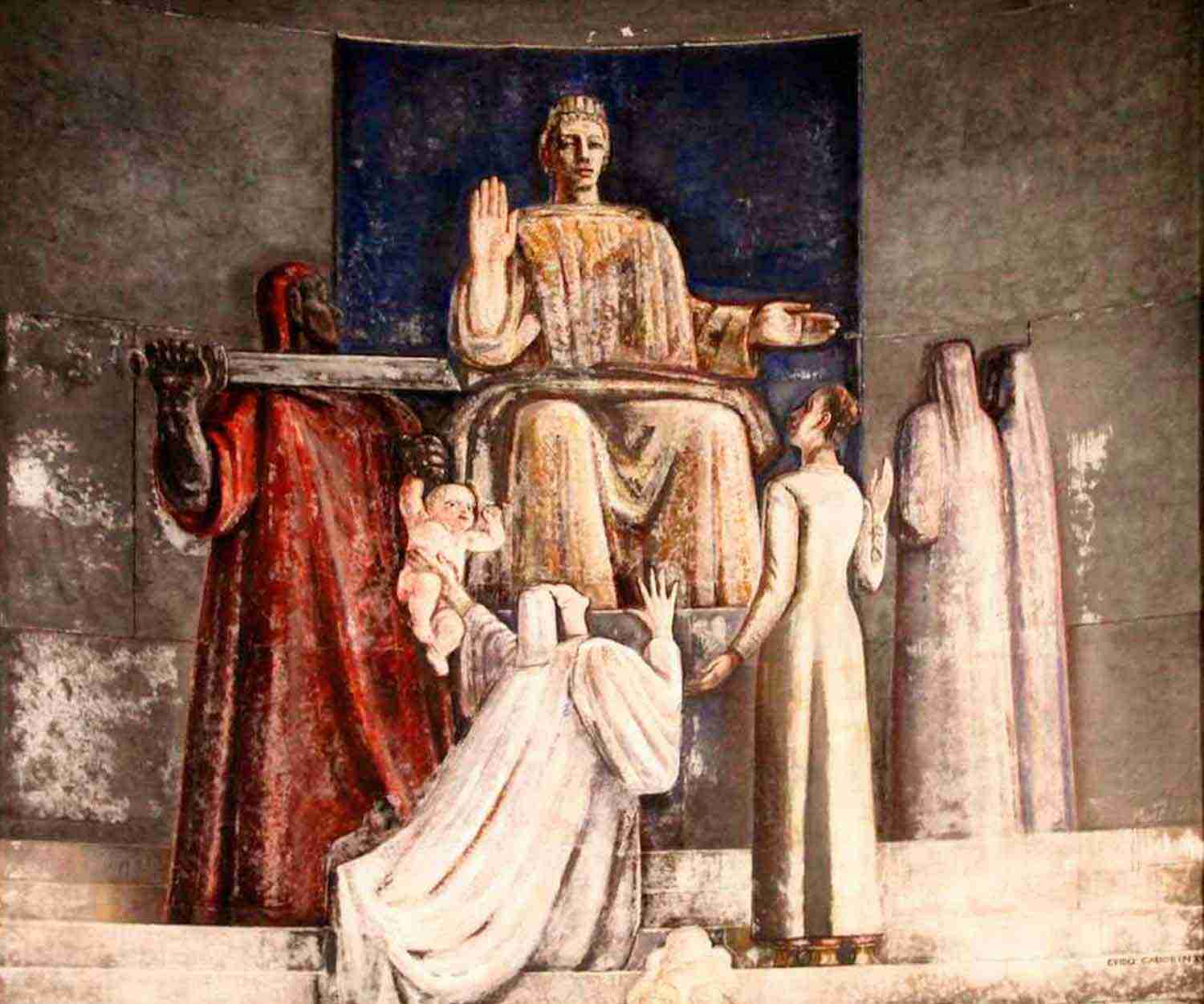
Giudizio di Salomone (Judgement of Solomon), 1924, fresco, Palazzo di Giustizia, Milan.
He participates with numerous works at the Venice Biennale, where he also frescoes one of the four panels for the Rotunda; he executes the fresco depicting The Judgement of Solomon for the Palace of Justice in Milan; he also presents two sketches in the competition for the fresco decoration of the atrium of the Liviano, the seat of the Faculty of Letters and Philosophy at the University of Padua.
Giudizio di Salomone (Judgement of Solomon), 1924, fresco, Palazzo di Giustizia, Milan.
1939
Altarpiece for the parish church in Pero (Treviso) and mosaic panels representing the masks of the commedia dell’arte for the San Marco cinema in Venice.
1940
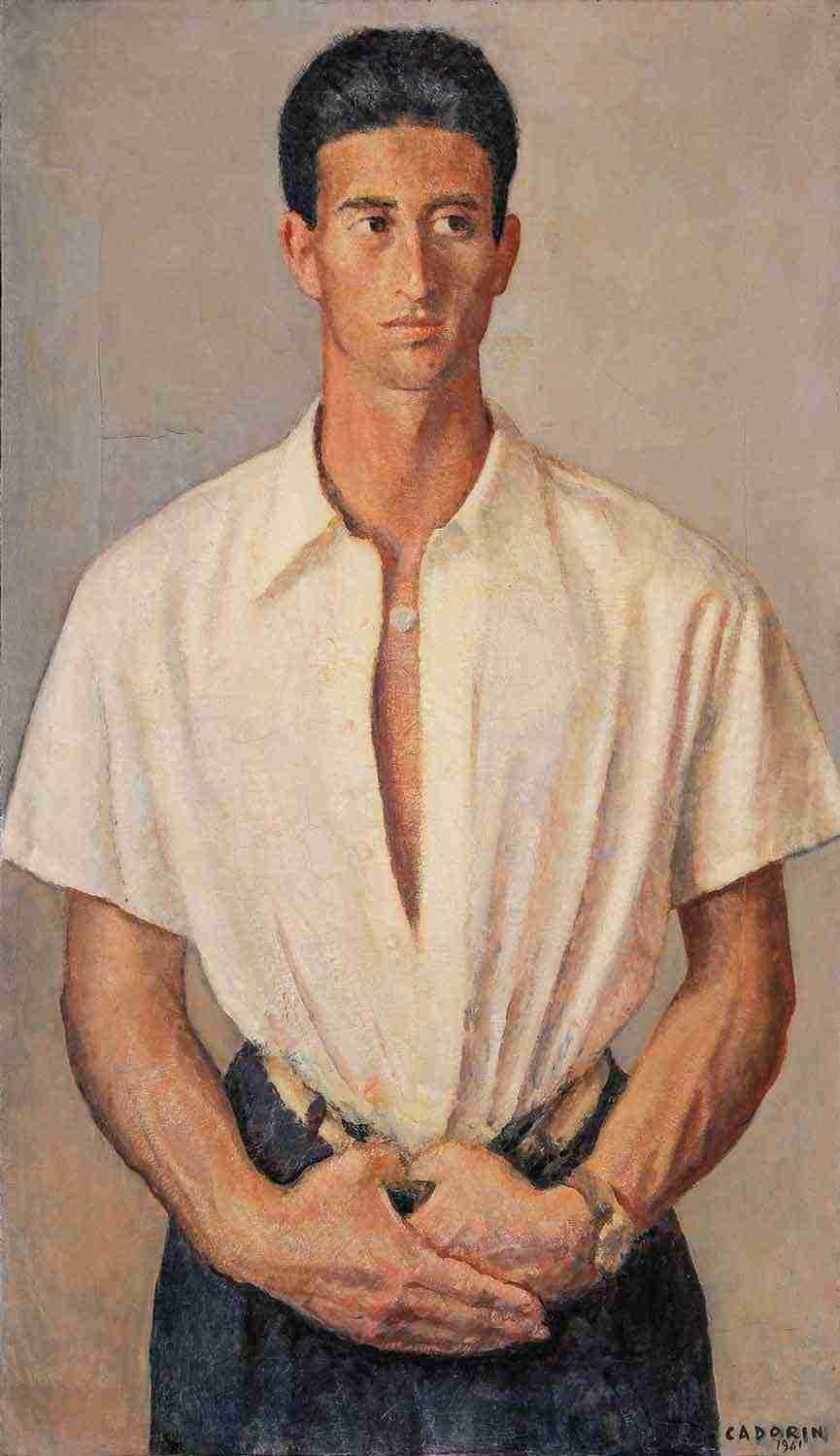
Ritratto di mio figlio (Portrait of my son), 1941, oil on canvas 116 x 67 cm.
He exhibits at the Galleria Asta in Milan; he executes three large tempera paintings for the central hall of the headquarters of the ‘Gazzettino’ newspaper in Palazzo Giustinian Faccanon in Venice.
Ritratto di mio figlio (Portrait of my son), 1941, oil on canvas 116 x 67 cm.
1942
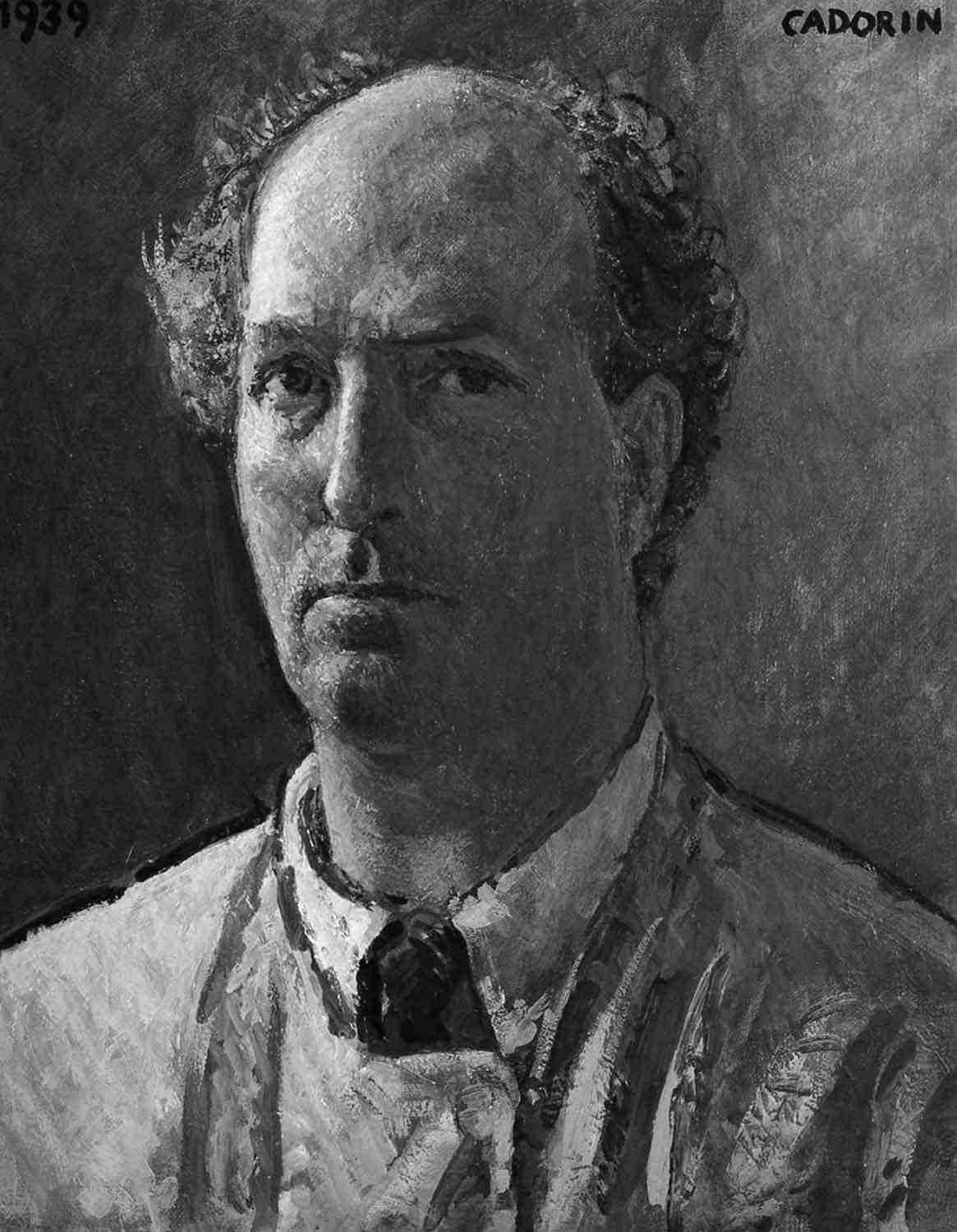
Autoritratto (Self-portrait), 1939, oil on canvas 55 x 45 cm, Galleria d’Arte Moderna, Palazzo Pitti, Florence.
The Venice Biennale dedicates a solo exhibition to him. One of his Self-portraits from 1939, exhibited on that occasion, is donated by the artist to the Galleria d’Arte Moderna at Palazzo Pitti in Florence.
Autoritratto (Self-portrait), 1939, oil on canvas 55 x 45 cm, Galleria d’Arte Moderna, Palazzo Pitti, Florence.
1946
He paints a large cycle of mural paintings for the parish church of Cadola (Belluno), assisted by his daughter Ida, Zoran Music and Sylva Bernt.
1948
He exhibits at the Quadriennale in Rome and the Venice Biennale.
1949
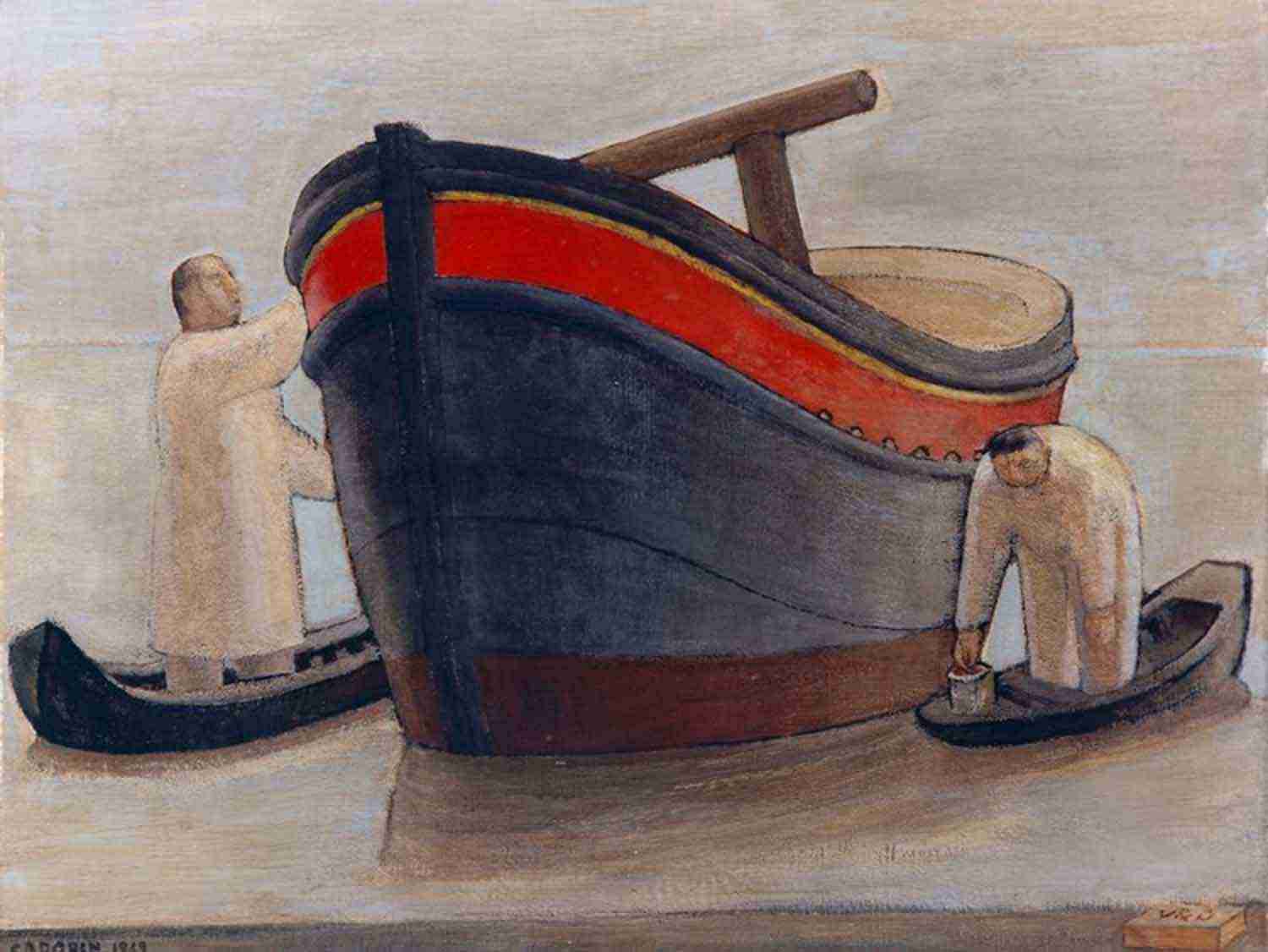
Pittori di barche (Boat painters), 1949, oil on canvas 70 x 90 cm, Palazzo Romagnoli, Collezioni del Novecento, Forlì.
Group exhibitions in Cairo, Toulouse and Venice.
Pittori di barche (Boat painters), 1949, oil on canvas 70 x 90 cm, Palazzo Romagnoli, Collezioni del Novecento, Forlì.
1950
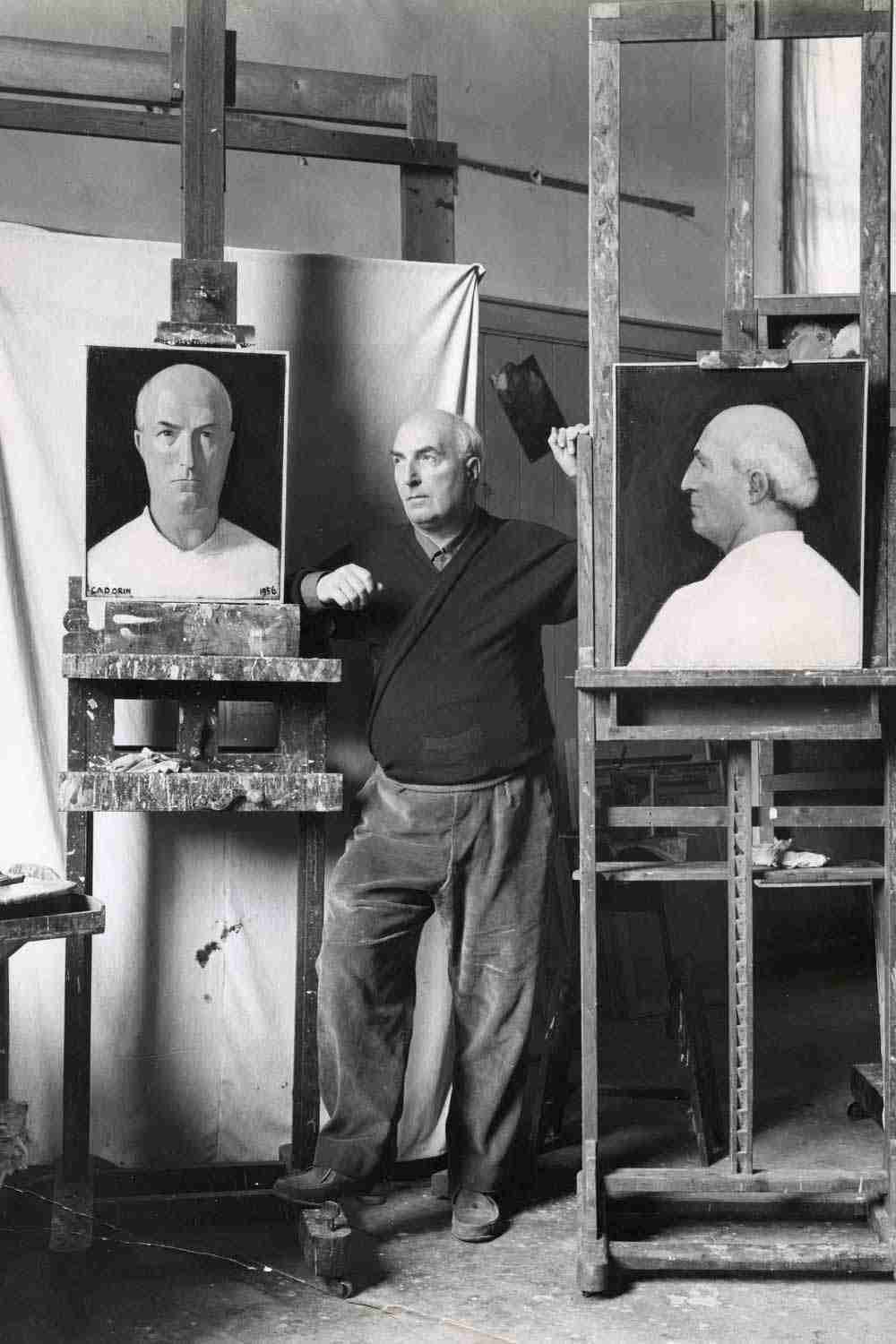
The painter in his studio at the Accademia di Belle Arti in Venice: the painting on the right (Self-portrait, 1950) is now in the collection of the Musei Civici in Treviso.
He participates in the Venice Biennale.
The painter in his studio at the Accademia di Belle Arti in Venice: the painting on the right (Self-portrait, 1950) is now in the collection of the Musei Civici in Treviso.
1951
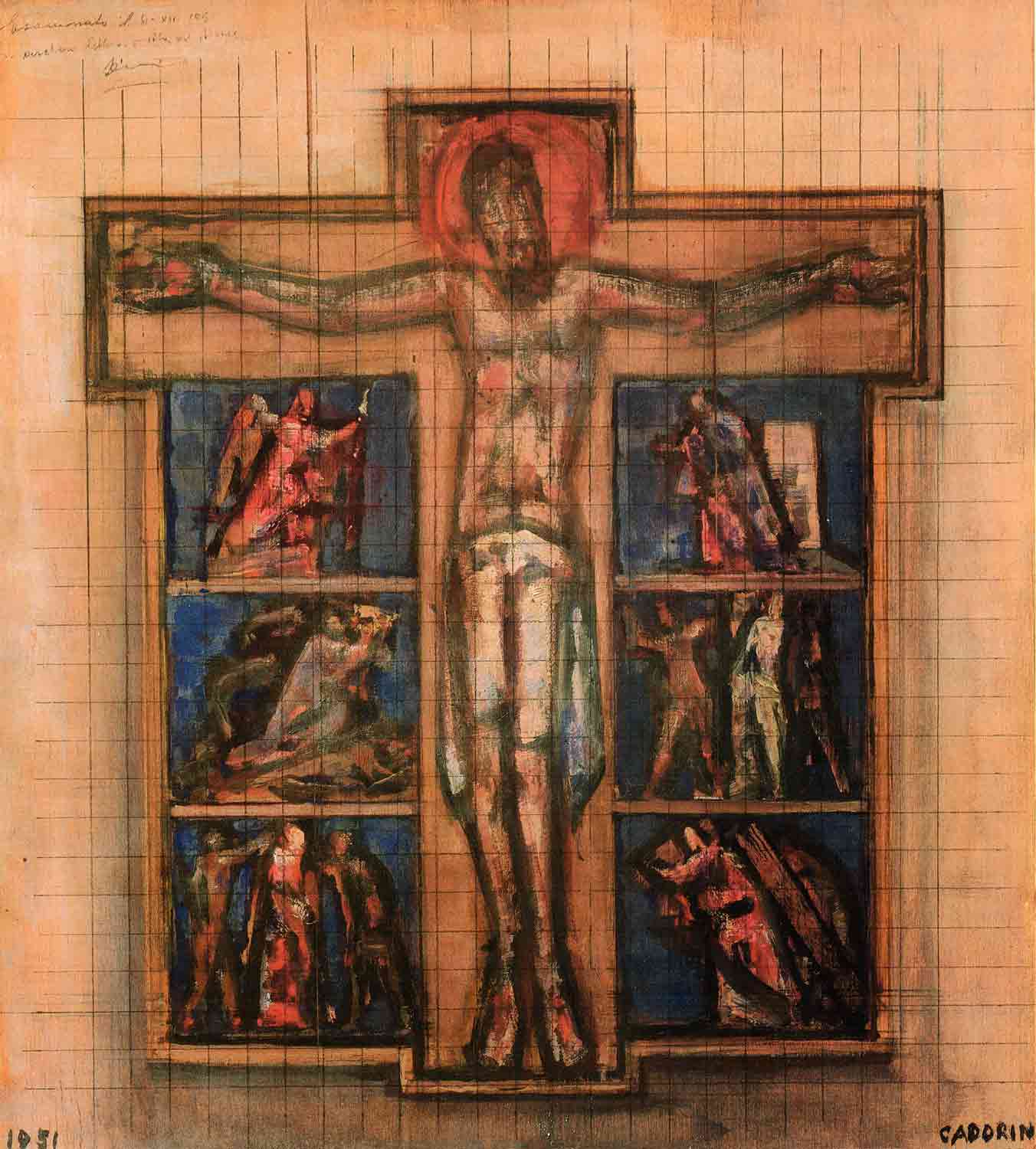
Crocifissione (Crucifixion), tempera and pencil on panel 60 x 55 cm. Study for the church of Recoaro Terme, Vicenza.
He wins the competition for an altarpiece in the church of Recoaro Terme: a mosaic that he would complete in 1955.
Crocifissione (Crucifixion), tempera and pencil on panel 60 x 55 cm. Study for the church of Recoaro Terme, Vicenza.
1952 - 1953
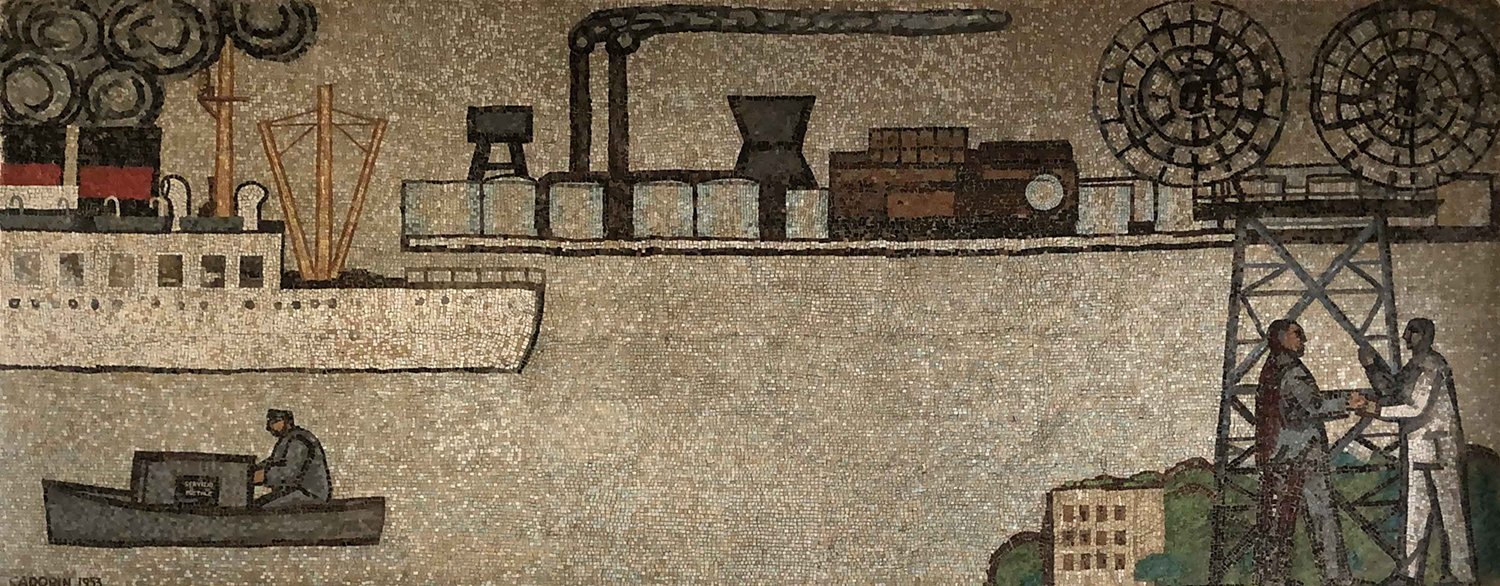
Mosaic for the Palazzo delle Poste in Mestre
He exhibits at the Venice Biennale, in Barcelona, at the Círculo de Bellas Artes in Madrid, and at the Galerie Charpentier in Paris. In 1953 he produces the mosaic panel for the Palazzo delle Poste in Mestre; he exhibits at the California Palace of the Legion of Honour in San Francisco and at the Galleria dell’Accademia in Florence (IV Mostra Nazionale Premio del Fiorino).
Mosaic for the Palazzo delle Poste in Mestre
1956
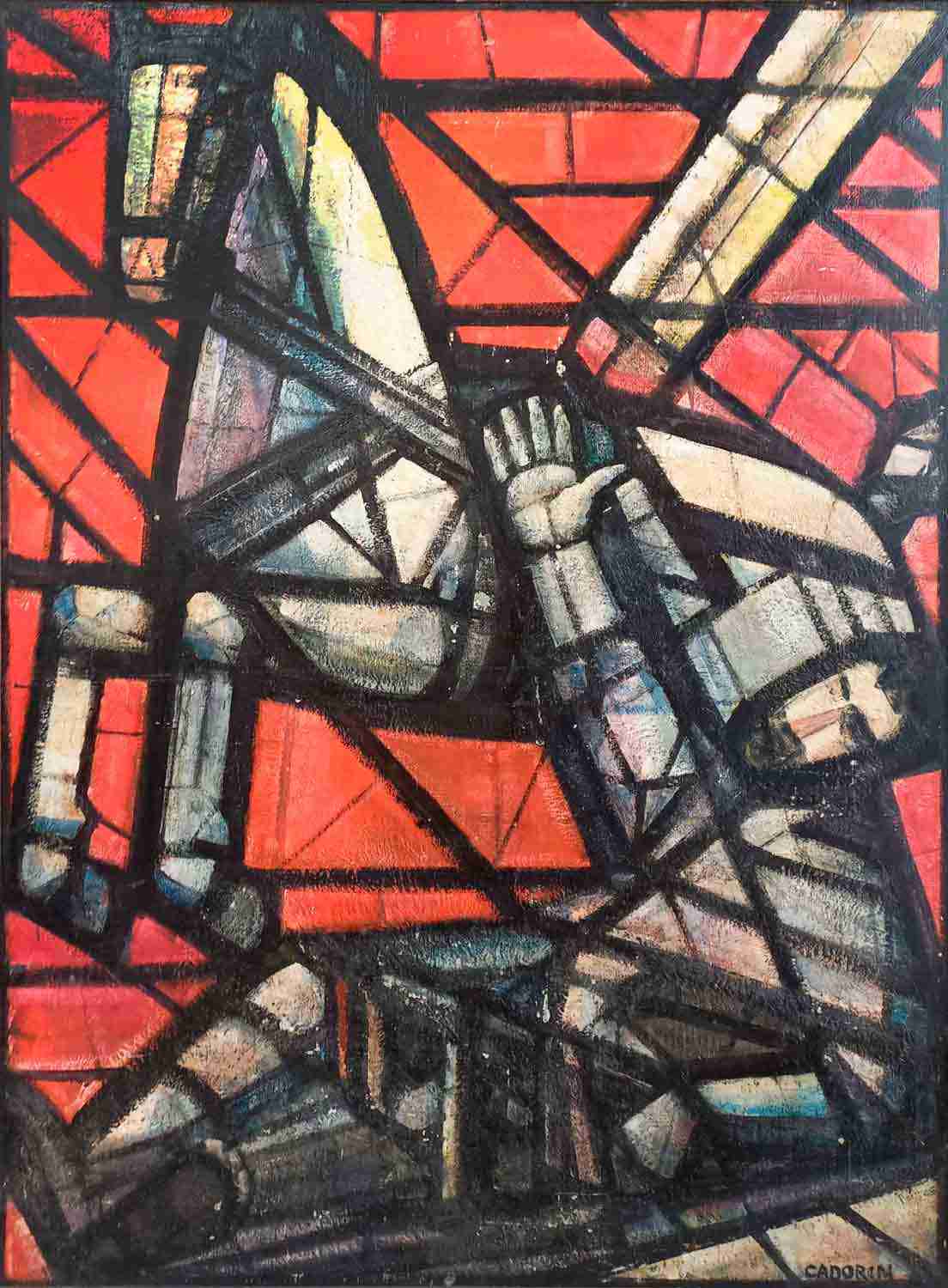
Sketch for a stained-glass window depicting the Conversion of Saul.
He wins equal first prize for the stained glass windows of the church of San Niccolò in Lugano, which would never be executed.
Sketch for a stained-glass window depicting the Conversion of Saul.
1957
Virgilio Guidi organises a large anthological exhibition of his work in the Sala Napoleonica of the Museo Correr in Venice.
1958
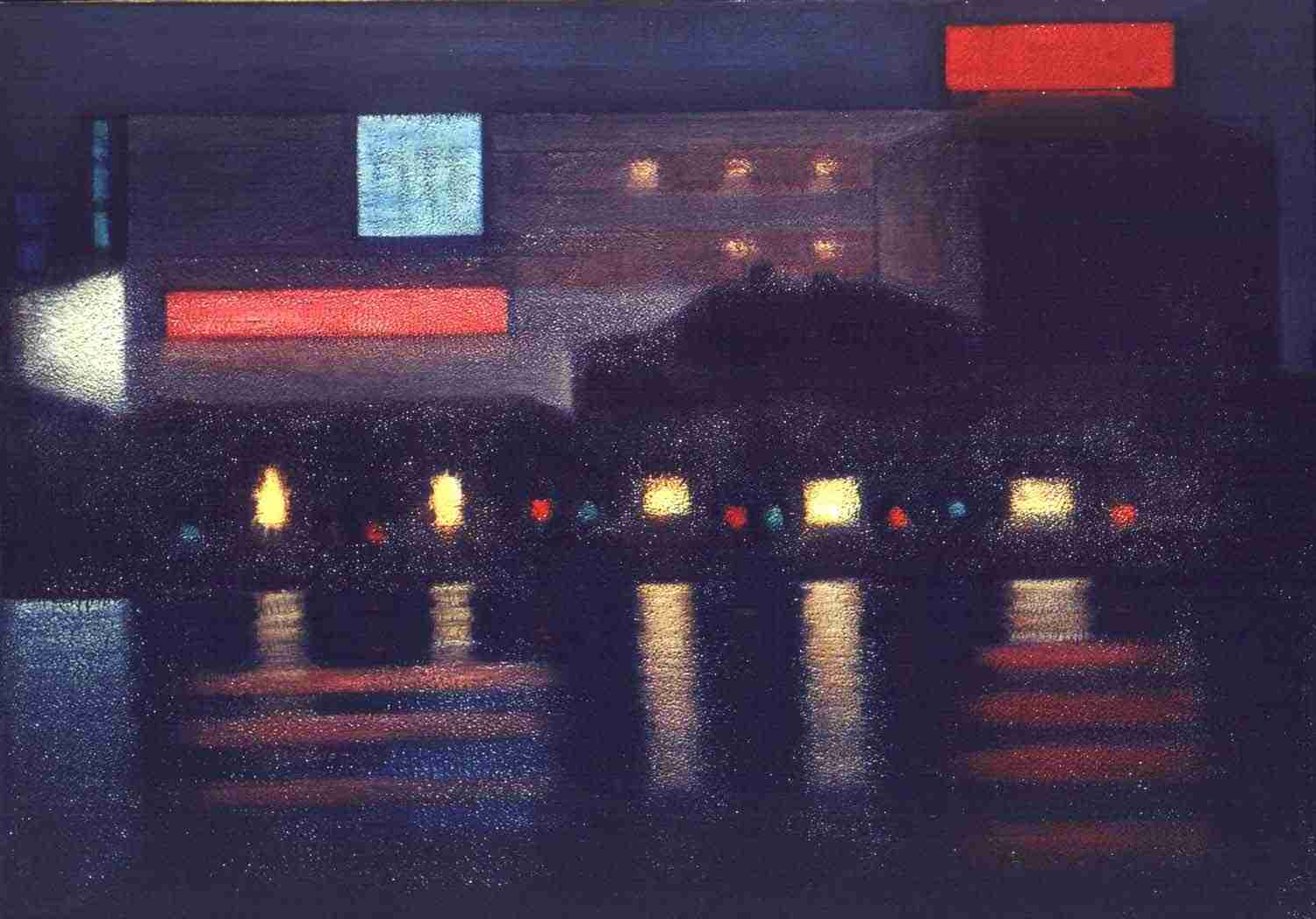
Piazzale Roma, 1958, oil on canvas 115 x 160 cm.
He exhibits at the Primi espositori di Ca’ Pesaro 1908–1919 exhibition organised by the Opera Bevilacqua La Masa in the Sala Napoleonica of the Museo Correr, curated by Guido Perocco.
Piazzale Roma, 1958, oil on canvas 115 x 160 cm.
1962
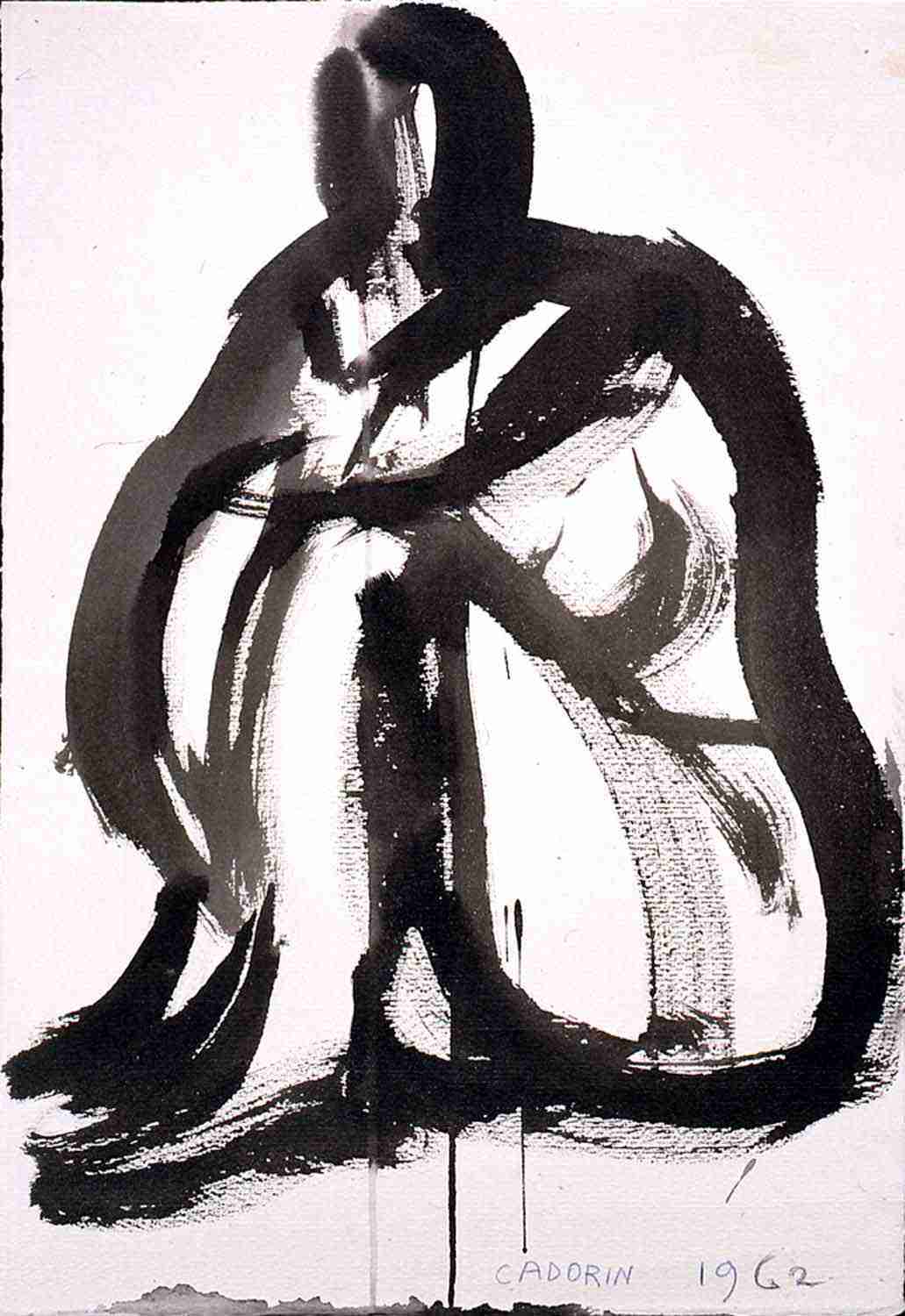
Senza titolo (figura femminile) (Untitled (female figure)), 1962, watercolour on paper 55 x 36 cm, Galleria d’Arte Contemporanea Osvaldo Licini, Ascoli Piceno.
He leaves his teaching post at the Accademia di Belle Arti in Venice due to the age limit. He receives a first-class commendation and the Gold Medal of the President of the Republic for Art and Culture.
Senza titolo (figura femminile) (Untitled (female figure)), 1962, watercolour on paper 55 x 36 cm, Galleria d’Arte Contemporanea Osvaldo Licini, Ascoli Piceno.
1965
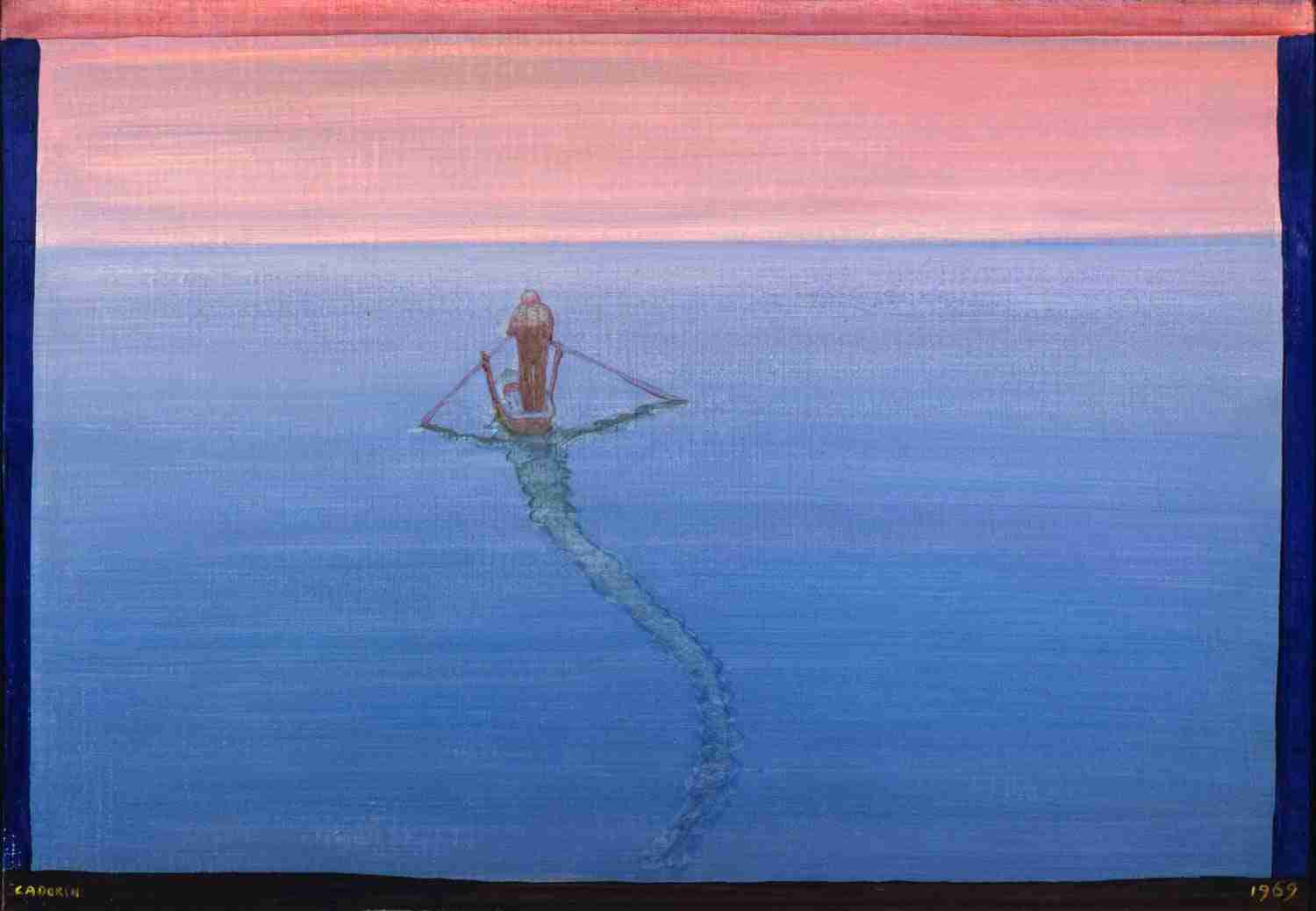
The Lagoon at Pellestrina (Lagoon and Boat)), 1966-1969, oil on canvas 70 x 100 cm.
His works are exhibited at the Exposition de la peinture italienne contemporaine in Zurich and at the Premio Nazionale Ardengo Soffici in Prato.
The Lagoon at Pellestrina (Lagoon and Boat)), 1966-1969, oil on canvas 70 x 100 cm.
1967
Carlo Ludovico Ragghianti includes him in the major exhibition entitled Arte moderna in Italia 1915–1935 at Palazzo Strozzi in Florence, while the City of Venice sponsors an extensive anthological exhibition at the Casino del Lido, curated by Paolo Rizzi.
1968
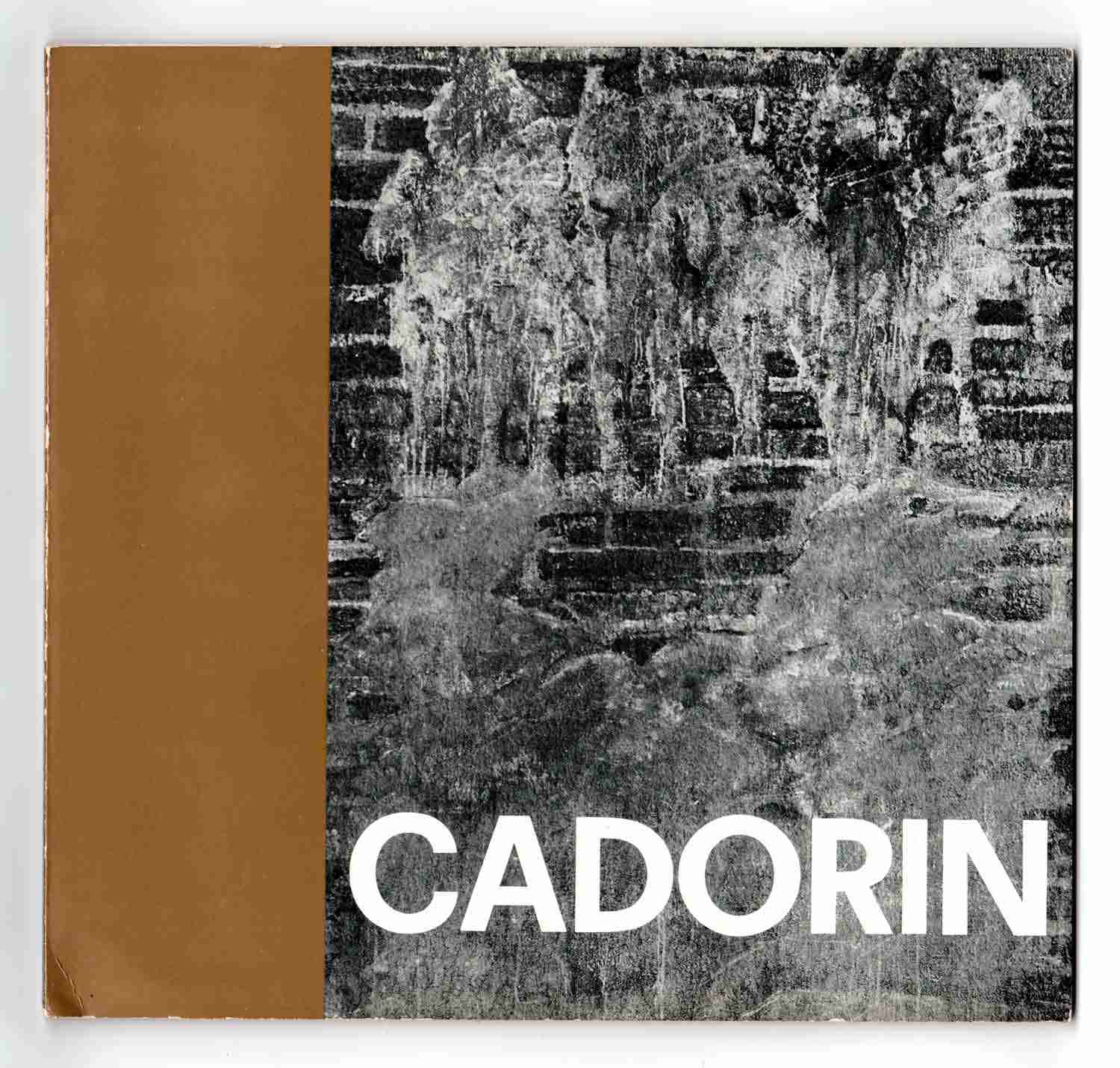
Cover of the catalogue, with a reproduction of the oil on canvas entitled Il muro (The Wall), 1965.
The Gallerie dell’Accademia in Venice organises an extensive retrospective (catalogue with texts by G. Marchiori, S. Branzi, U. Apollonio, B. Morucchio, M. Valsecchi, P. Rizzi).
Cover of the catalogue, with a reproduction of the oil on canvas entitled Il muro (The Wall), 1965.
1972
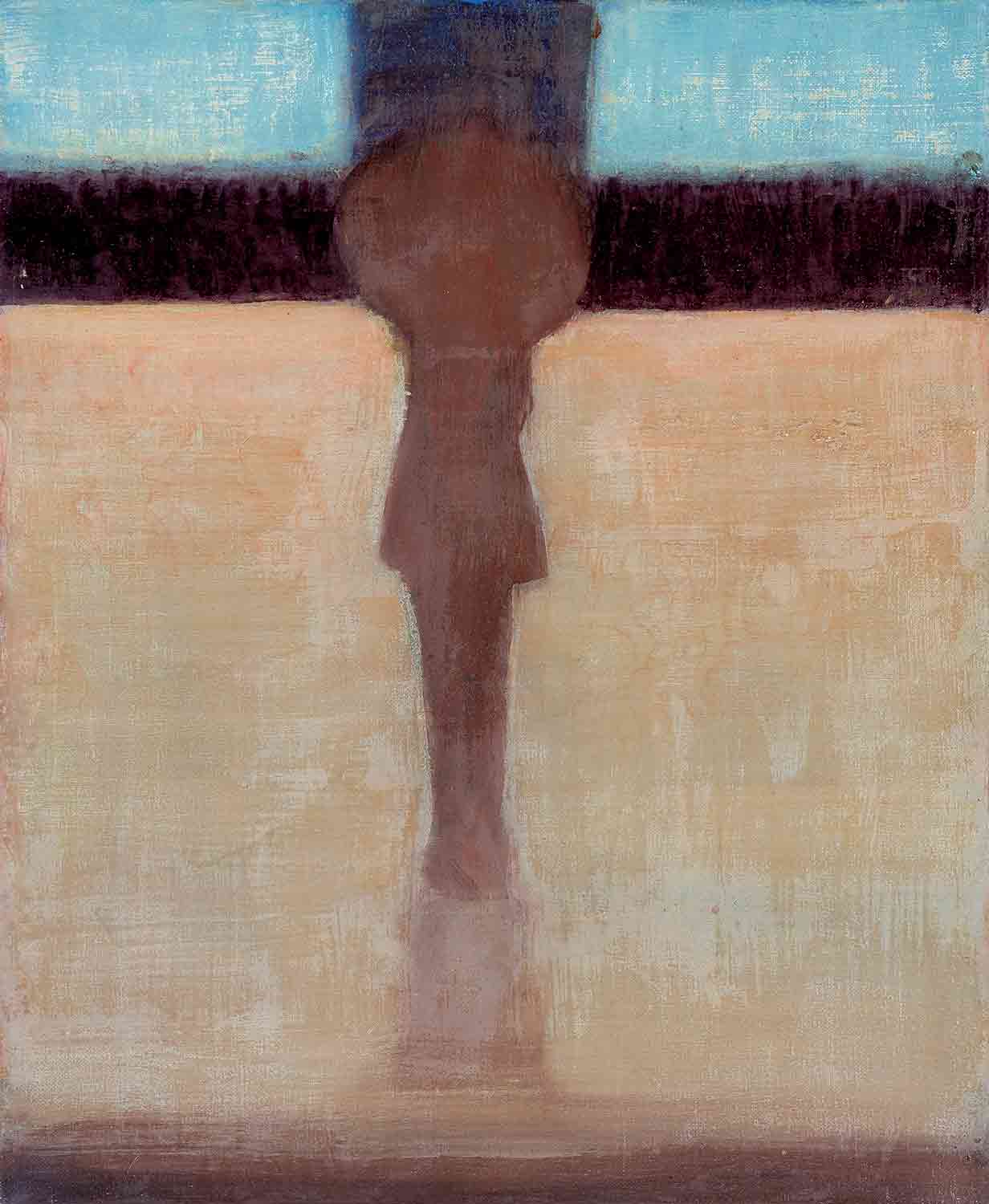
Figura nella pioggia (Figure in the rain), 1972, oil on canvas 61 x 50 cm.
His wife Livia dies.
Figura nella pioggia (Figure in the rain), 1972, oil on canvas 61 x 50 cm.
1975
Guido Cadorin’s long artistic career comes to an end. As his last effort, he paints a Madonna with “sweet and compassionate eyes” for his friend Don Pietro Ceccato.
1976
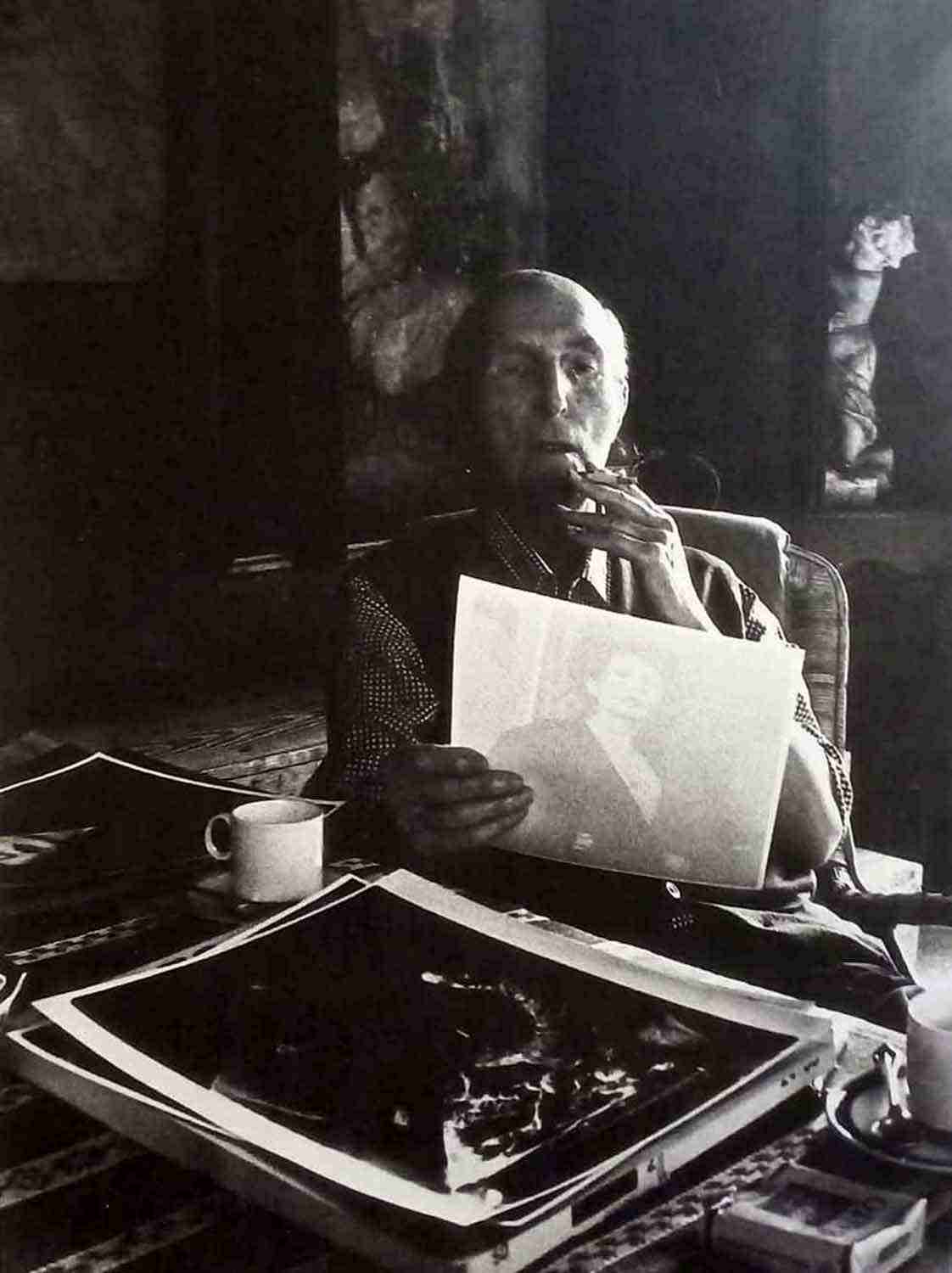
Guido Cadorin nella sua casa ai Carmini, 1976 (Archivio BCM).
He dies in Venice on 18 August.
Guido Cadorin nella sua casa ai Carmini, 1976 (Archivio BCM).